After reading this page, you will understand…
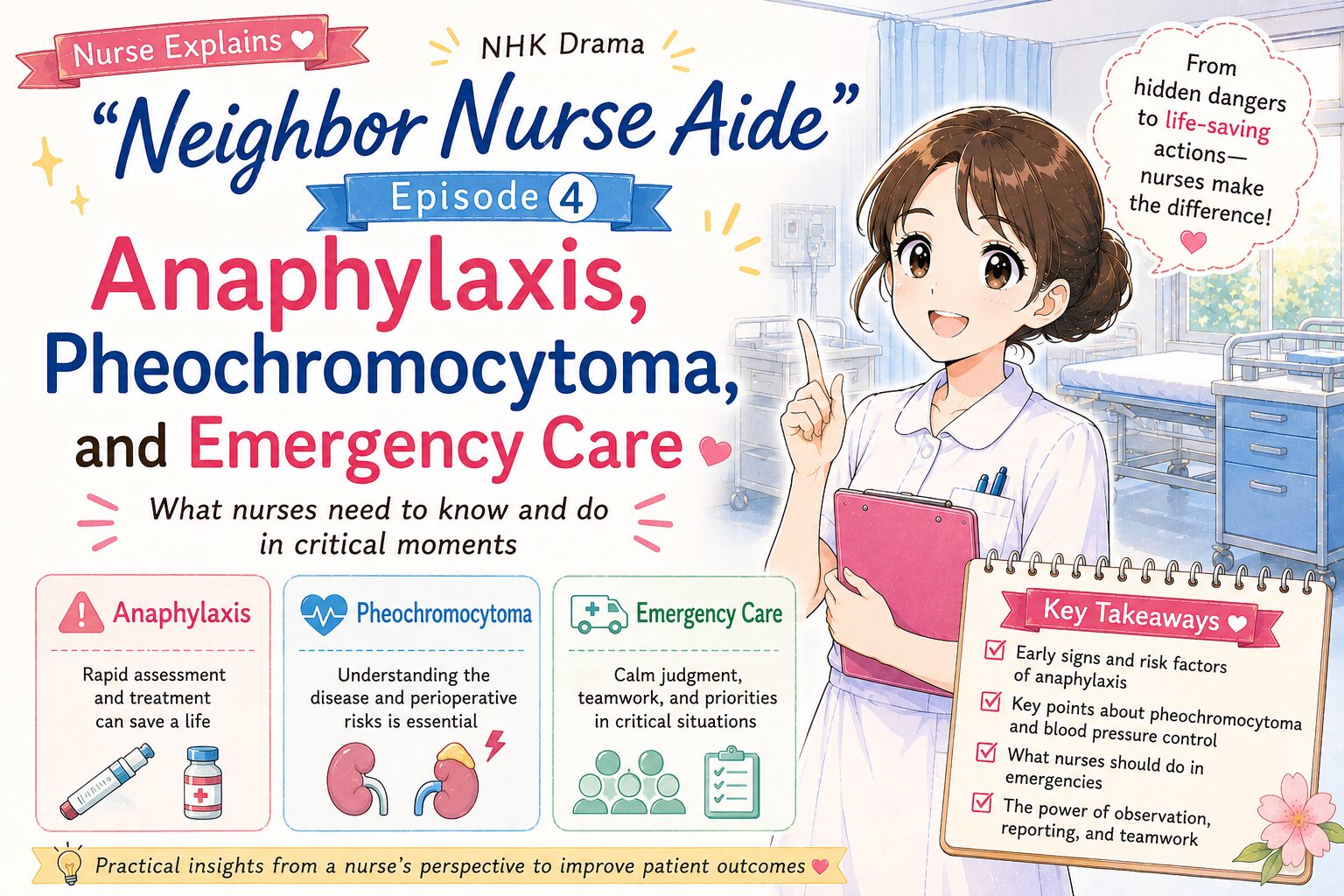
✅ The story of Episode 4 of “Neighbor Nurse Aide” from a nurse’s point of view
✅ The symptoms of anaphylactic shock and the correct response steps
✅ How pheochromocytoma and excess catecholamines can lead to high-output heart failure
✅ What Mio’s growth teaches us about courage while living with PTSD
✅ How nurses can move during out-of-hospital emergencies
Hello, I’m Shii-chan, an active nurse.
I have 20 years of experience as a veteran nurse and currently work as a certified critical care nurse.
I’m Mirai-chan! I’m a first-year nurse, and every time I watch a medical drama, I ask Shii-chan all kinds of questions.
This time, I’ll take a close nurse’s-eye look at Episode 4 of the Monday 9 PM drama “Neighbor Nurse Aide.” I packed it with points that new nurses can use in real clinical settings.
Mirai-chan: Shii-chan, the family restaurant scene where someone suddenly collapsed in Episode 4 had me glued to the screen! When Mio gave adrenaline even while struggling with PTSD, I almost cried.
Shii-chan: I know. That scene really hit me as a healthcare worker. The way it showed “I can move because a patient’s life is on the line” was excellent. Today, we’ll focus on anaphylaxis and pheochromocytoma, and we’ll also review how to respond to emergencies outside the hospital.
- Episode 4 Summary from a Nurse’s Perspective
- Nurse’s Point 1: Understanding the Basics of Anaphylactic Shock
- Nurse’s Point 2: Don’t Miss the Symptoms of Anaphylaxis
- Nurse’s Point 3: Response Steps for Anaphylactic Shock
- Nurse’s Point 4: The Nurse’s Role in Out-of-Hospital Emergencies
- Nurse’s Point 5: What Is Pheochromocytoma?
- Nurse’s Point 6: Remember the Classic Triad of Pheochromocytoma
- Nurse’s Point 7: Why Pheochromocytoma Can Cause High-Output Heart Failure
- Nurse’s Point 8: Diagnosis, Testing, and Nursing Care for Pheochromocytoma
- Nurse’s Point 9: Why Mio Could Still Move Despite PTSD
- Nurse’s Point 10: Episode 4 Combines Out-of-Hospital Emergency Care, Endocrine Disease, and Emotional Recovery
- Clinical Observation and Response Tips for New Nurses
- Examples of Reports to Senior Nurses or Physicians
- Frequently Asked Questions
- Summary: Episode 4 Is a Textbook Case for Strengthening Emergency Response Skills
- Recommended Resources from Shii-chan
- Recommended Resources 🛒
Episode 4 Summary from a Nurse’s Perspective
Mio hears from Detective Tachibana, her former boyfriend, that her older sister Yui may have been killed by Koji Tatsumi, the leader of a semi-criminal group. Confused and shaken, Mio tries to rely on Ryuzaki, but he keeps going out somewhere every night, and they repeatedly miss each other.
Meanwhile, a new character, Reika Higami, returns to the hospital after studying in the United States. Reika is a talented surgeon and has feelings for Ryuzaki. She notices Mio’s past as a former surgeon and begins looking into it.
Ryuzaki invites Mio to a live concert, giving her a short break. On the way home, however, they stop by a family restaurant, where a male customer suddenly collapses. It is anaphylactic shock caused by a peanut allergy. Mio had sealed away medical procedures because of PTSD, but after Ryuzaki says, “A patient’s life is at stake!” she injects adrenaline with trembling hands and saves his life.
Mio also correctly identifies the cause of an inpatient’s pulmonary edema due to left-sided heart failure as high-output heart failure caused by excessive catecholamine secretion from pheochromocytoma.
Then comes the shocking ending. Mio heads to a mountain mansion while pursuing the truth behind Yui’s death and Tatsumi’s hideout. A car appears in front of her. The person who steps out is… Ryuzaki.
Nurse’s Point 1: Understanding the Basics of Anaphylactic Shock
Anaphylaxis is a severe systemic allergic reaction to a specific allergen, such as food, medication, or bee venom. When circulatory collapse, or shock, occurs along with anaphylaxis, it is called anaphylactic shock.
Common allergens include foods such as peanuts, shellfish, wheat, milk, and eggs; medications such as penicillin, NSAIDs, and contrast agents; bee venom; and latex.
Mirai-chan: I didn’t realize peanuts could cause such severe allergies.
Shii-chan: They can. In many Western countries, allergy education starts early because peanut allergies are so common. Cases are also increasing in Japan, so it’s something nurses need to remember well.
Nurse’s Point 2: Don’t Miss the Symptoms of Anaphylaxis
Anaphylaxis can become life-threatening within minutes, so early recognition saves lives. The main symptoms are as follows.
- Skin and mucosa: hives, redness, swelling, especially of the face, mouth, or throat
- Respiratory: throat tightness, hoarseness, wheezing, difficulty breathing, cyanosis
- Circulatory: tachycardia, low blood pressure, fainting
- Gastrointestinal: nausea, vomiting, abdominal pain
- Neurological: anxiety, loss of consciousness
The basic rule is simple: if symptoms appear in multiple organ systems at the same time, suspect anaphylaxis.
Shii-chan: Skin symptoms alone may be a mild allergic reaction, but once breathing or circulation is involved, you must immediately suspect anaphylactic shock and act.
Nurse’s Point 3: Response Steps for Anaphylactic Shock
The scene where Mio injected adrenaline was exactly the kind of response described in textbooks.
- Call loudly for help and secure more people
- Place the patient supine, or in a semi-sitting position if severe breathing difficulty is present
- Inject 0.3 mg of adrenaline, also called epinephrine, intramuscularly into the lateral thigh
- Administer oxygen and secure an IV line
- Call emergency services and prepare an AED
- If there is no improvement within 5 to 15 minutes, give an additional dose of adrenaline
The key point is that adrenaline is the first-line treatment. Antihistamines and steroids are supportive therapies; they must not delay adrenaline.
Mirai-chan: I thought I knew that adrenaline comes first, but I’m not sure I could say the steps in order.
Shii-chan: Practice with simulations again and again. Procedures learned through the body will help you move when the real moment comes.
Nurse’s Point 4: The Nurse’s Role in Out-of-Hospital Emergencies
The family restaurant scene is an out-of-hospital emergency. Responding without medical devices or medications at hand is one of the most difficult situations for healthcare workers.
When acting as a healthcare professional outside the hospital, the basic approach is:
- Identify yourself: “I’m a nurse. I can help.”
- Ask people nearby to call emergency services and bring an AED
- Check consciousness, breathing, and pulse, then start CPR or other lifesaving care as needed
- Use available resources such as an EpiPen or AED
- Prepare a clear handoff for the emergency medical team
Shii-chan: Because this is a situation where “I couldn’t do anything” is not enough, it’s important to build the habit of asking yourself, “How would I move?” in everyday life.
Nurse’s Point 5: What Is Pheochromocytoma?
Pheochromocytoma is a catecholamine-producing tumor that arises from the adrenal medulla or from paraganglia. By secreting excessive catecholamines such as adrenaline, noradrenaline, and dopamine, it can affect many organs throughout the body.
It commonly appears in people in their 30s to 50s. In Japan, about 800 to 1,000 cases are diagnosed each year, and about 10% are considered malignant.
Mirai-chan: Where are the adrenal glands again?
Shii-chan: They’re small organs sitting on top of the kidneys. They may be small, but they release powerful hormones, so when something goes wrong, the whole body can be affected.
Nurse’s Point 6: Remember the Classic Triad of Pheochromocytoma
Pheochromocytoma has a textbook triad that new nurses should definitely remember.
- Headache, often pulsating and sudden
- Sweating, often profuse or cold
- Palpitations and tachycardia
Paroxysmal hypertension is also characteristic: blood pressure suddenly rises and later returns closer to normal. When a patient’s blood pressure rises abruptly for no clear reason, include pheochromocytoma in your differential thinking.
Nurse’s Point 7: Why Pheochromocytoma Can Cause High-Output Heart Failure
This is one of the key medical points in the episode. When catecholamines are secreted excessively, heart failure can occur through the following mechanism.
Excess catecholamines → increased heart rate and peripheral vasoconstriction → greatly increased cardiac workload → reduced left ventricular function → pulmonary congestion and pulmonary edema
Typical heart failure is often thought of as low-output heart failure, where cardiac function drops and output decreases. In pheochromocytoma, however, the heart can become exhausted after being overdriven by catecholamines. This is the pattern referred to as high-output heart failure.
Shii-chan: Not only noticing “this is pulmonary edema,” but also asking “why did pulmonary edema happen?” is the mindset that leads you toward becoming a more experienced nurse.
Nurse’s Point 8: Diagnosis, Testing, and Nursing Care for Pheochromocytoma
The following tests are used to diagnose pheochromocytoma.
- Blood and urine catecholamine measurements, including adrenaline and noradrenaline
- 24-hour urine metanephrine and normetanephrine measurements
- Adrenal CT or MRI to identify the tumor
- MIBG scintigraphy for functional imaging
The key nursing points are frequent blood pressure monitoring and preparation for sudden deterioration. Paroxysmal hypertension can happen without warning, so regular vital sign checks and readiness to administer medications such as calcium channel blockers or alpha blockers are important.
Nurse’s Point 9: Why Mio Could Still Move Despite PTSD
Mio could not perform medical procedures because of PTSD, yet she was able to give adrenaline in the family restaurant. Many viewers were moved because the scene showed how courage and another person’s life can push someone beyond their perceived limits.
In real clinical practice, nurses who continue working while carrying trauma are not rare. What matters is not forcing yourself to bear everything alone, but receiving support step by step and gradually expanding what you are able to do.
Mirai-chan: Watching Mio made me feel that it’s possible to move forward even when I’m scared.
Shii-chan: Yes. But remember, asking for help and recovering first is often better for patients than pushing yourself until you can’t move at all. You don’t have to be a hero.
Nurse’s Point 10: Episode 4 Combines Out-of-Hospital Emergency Care, Endocrine Disease, and Emotional Recovery
Episode 4 was medically dense. It covered anaphylactic shock, pheochromocytoma, and high-output heart failure, bringing together knowledge from allergy, endocrinology, and cardiology all at once.
It also included the psychological theme of taking one step forward from PTSD and the practical challenge of an emergency outside the hospital. In that sense, it was an episode that tested the “comprehensive strength” of nursing.
Clinical Observation and Response Tips for New Nurses
1. Recognize Anaphylaxis in Five Seconds
Train yourself to react when skin symptoms plus either respiratory or circulatory symptoms appear. Repeated simulation helps make this response automatic.
2. Check the Location of Adrenaline Every Day
From your first day on a ward, know where the anaphylaxis response kit is stored. In an emergency, losing even a few seconds wondering “where is it?” matters.
3. Monitor Vital Signs Closely in Patients with Paroxysmal Hypertension
When a patient’s blood pressure differs greatly each time you measure it, think about paroxysmal causes such as pheochromocytoma or vasospasm.
4. Think One Level Deeper About the Cause of Pulmonary Edema
Do not stop at “pulmonary edema equals heart failure.” Ask why that heart failure occurred. Identifying the cause can lead to definitive treatment.
5. In Out-of-Hospital Emergencies: Identify Yourself, Delegate, and Act
Introduce yourself as a healthcare professional, ask bystanders to call emergency services and bring an AED, then begin lifesaving care. Speaking clearly helps calm everyone around you.
Examples of Reports to Senior Nurses or Physicians
Emergency Report for Suspected Anaphylaxis
“Mr./Ms. XX developed hives, lip swelling, and wheezing after eating. BP is 70/40 and HR is 130. I suspect anaphylactic shock. We are preparing intramuscular adrenaline and the emergency cart. Please come immediately.”
Paroxysmal Hypertension with Suspected Pheochromocytoma
“Mr./Ms. XX’s BP suddenly rose to 220/120 at rest and returned to the 150s within a few minutes. Headache, sweating, and palpitations are also present. I would like to consult you about evaluation for pheochromocytoma.”
High-Output Heart Failure and Pulmonary Edema
“Mr./Ms. XX has orthopnea, frothy sputum, and SpO2 87% on room air. BP is 180/110 and HR is 130. There is a history of pheochromocytoma, so I suspect catecholamine-induced pulmonary edema. Please advise regarding alpha blockade and oxygenation.”
Handoff After an Out-of-Hospital Emergency
“At XX:XX, the patient developed anaphylactic shock outside the hospital. After 0.3 mg intramuscular adrenaline was given in the thigh, vital signs stabilized. The reported allergen was peanuts. Please provide instructions for allergy registration and observation.”
Frequently Asked Questions
Q. Are EpiPen and adrenaline injection the same thing?
An EpiPen is an auto-injector formulation of adrenaline, also called epinephrine. The active ingredient is the same, but an EpiPen is designed so patients or family members can use it, while adrenaline injections used by healthcare professionals involve different administration procedures.
Q. Can pheochromocytoma be cured with surgery?
If it is benign, laparoscopic adrenalectomy can often provide a cure. Preoperative blood pressure control with alpha blockers is extremely important. Without adequate preparation, severe hypertensive crisis can occur during surgery.
Q. Does a nurse have a legal duty to help during an out-of-hospital emergency?
In Japan, there is no general legal rescue duty in the same sense as a mandatory obligation. However, the Japanese Nursing Association’s Code of Ethics asks nursing professionals to provide support when life or health is at risk. Legal protections for good-faith rescuers have also been developing.
Q. What are other causes of high-output heart failure?
Representative causes include severe anemia, hyperthyroidism, arteriovenous fistula, and vitamin B1 deficiency, also known as beriberi heart disease. The key pattern is “heart failure even though the heart is working too hard.”
Summary: Episode 4 Is a Textbook Case for Strengthening Emergency Response Skills
Episode 4 of “Neighbor Nurse Aide” was a dense episode where viewers could learn about acute conditions that can truly appear in clinical practice: anaphylactic shock, pheochromocytoma, and high-output heart failure.
Just as Mio took a step forward while living with PTSD, new nurses gradually build the ability to save lives by repeatedly experiencing moments where they are scared but still move.
Shii-chan: Mirai-chan, you worked hard again today. Let’s keep learning together next time.
Mirai-chan: Yes, Shii-chan! I’m scared to learn Ryuzaki’s secret in Episode 5, but I can’t stop wondering about it.
Recommended Resources from Shii-chan
For Tired Nurses: A Patented Chiropractic Pillow for Better Sleep
Long shifts on your feet, shoulder stiffness after night duty, neck pain… nurses’ bodies go through so much every day. One product I found helpful is Cure:Re THE MAKURA, a patented pillow developed by a bodywork specialist. It is designed to support the neck, shoulders, and back while you sleep. If you rarely have time to visit a bodywork clinic, this may be worth considering.
Patented chiropractic pillow: Cure:Re THE MAKURA
For Nurses Considering a Career Change: Find a Better Workplace with MC Nurse Net
If you feel that your current workplace is wearing you down, that feeling may be a sign. MC Nurse Net is a career support service for nurses, public health nurses, and midwives. A consultant can help you look for workplaces that match your preferences, including non-public job listings. Registration and consultation are free, so you can start by simply asking for information.
- Many non-public job listings
- Dedicated consultants support your career change
- Registration and use are completely free
Skill Up at Home: Skin Care Advisor Certification
Can you confidently answer patients’ skin care questions? The Skin Care Advisor correspondence course from the Japan Skincare Association lets you study the structure of the skin and proper skin care methods systematically. Because it is home study, it can fit around shift work, and the qualification can be useful for patient education, beauty-related side work, and everyday life.
- Distance learning you can do at home
- Useful for patient education in nursing and medical settings
- Official certification from the Japan Skincare Association
Skin Care Advisor correspondence course
Recommended Nursing Books and Exam References on Amazon
For readers who want to study more deeply or prepare for the national nursing exam, I introduce nursing-related books available on Amazon. I choose books that I have used myself or found genuinely helpful as an active nurse.
Recommended Resources 🛒
🛌 看護師の疲れた体に。特許取得の整体枕で熟睡できる眠りを
立ちっぱなしのシフト勤務、夜勤明けの肩こり・首こり……看護師のカラダって毎日本当にしんどいですよね。そんな私が出会ったのが、整体師が開発した特許取得の枕「Cure:Re THE MAKURA」。首・肩・背中のコリをほぐしながら寝られる設計で、翌朝の目覚めが全然違います。ふだん整体に行く余裕がない方にこそ試してほしい一品です。
💼 転職を考えているナースへ。MCナースネットで理想の職場を探そう
「今の職場、なんかしんどいな」と感じたら、それはサインかもしれません。MCナースネットは看護師・保健師・助産師専門の転職支援サービス。担当コンサルタントが非公開求人を含めた情報をもとに、あなたの希望にあった職場を一緒に探してくれます。登録・相談は無料なので、転職を決めていなくても「話だけ聞いてみる」から始めてOKです。
- 非公開求人も多数掲載
- 専任コンサルタントが転職をサポート
- 登録・利用は完全無料
。°+°。°+ °。°。°+°。°+ °。°。°+°。°+ °。°+ °。°
◇◆ 看護師の求人・転職ならMC─ナースネット ◆◇
業界最大級!求人数20000件以上、会員数100,000人の実績!
全国での拠点展開だから身近なコンサルタントに相談可!
大人気の企業・健診・添乗のお仕事も豊富!
登録・お問い合わせはこちら
⇒https://px.a8.net/svt/ejp?a8mat=4AVF01+3RQUPE+28MI+61JSJ
。°+°。°+ °。°。°+°。°+ °。°。°+°。°+ °。°+ °。°
✨ 看護師のスキルアップに。スキンケアアドバイザー資格を自宅で取得
患者さんのスキンケア相談、自信を持って答えられますか?一般社団法人日本スキンケア協会のスキンケアアドバイザー通信講座なら、肌の仕組みから正しいスキンケア方法まで体系的に学べます。自宅学習だからシフト勤務でも無理なく続けられ、取得した資格は患者さんへの指導・美容系への副業・日常生活にも活かせます。
- 自宅で学べる通信講座
- 看護・医療現場での患者指導にも活用できる
- 日本スキンケア協会が認定する公認資格
📚 しーちゃんのおすすめ看護本・国試参考書【Amazon】
「もっと深く勉強したい」「国試に向けてしっかり対策したい」という方へ。Amazonで購入できるおすすめの看護関連書籍をご紹介します。現役ナースの私が実際に使ったり、役立つと感じた本を厳選しています。
コメント