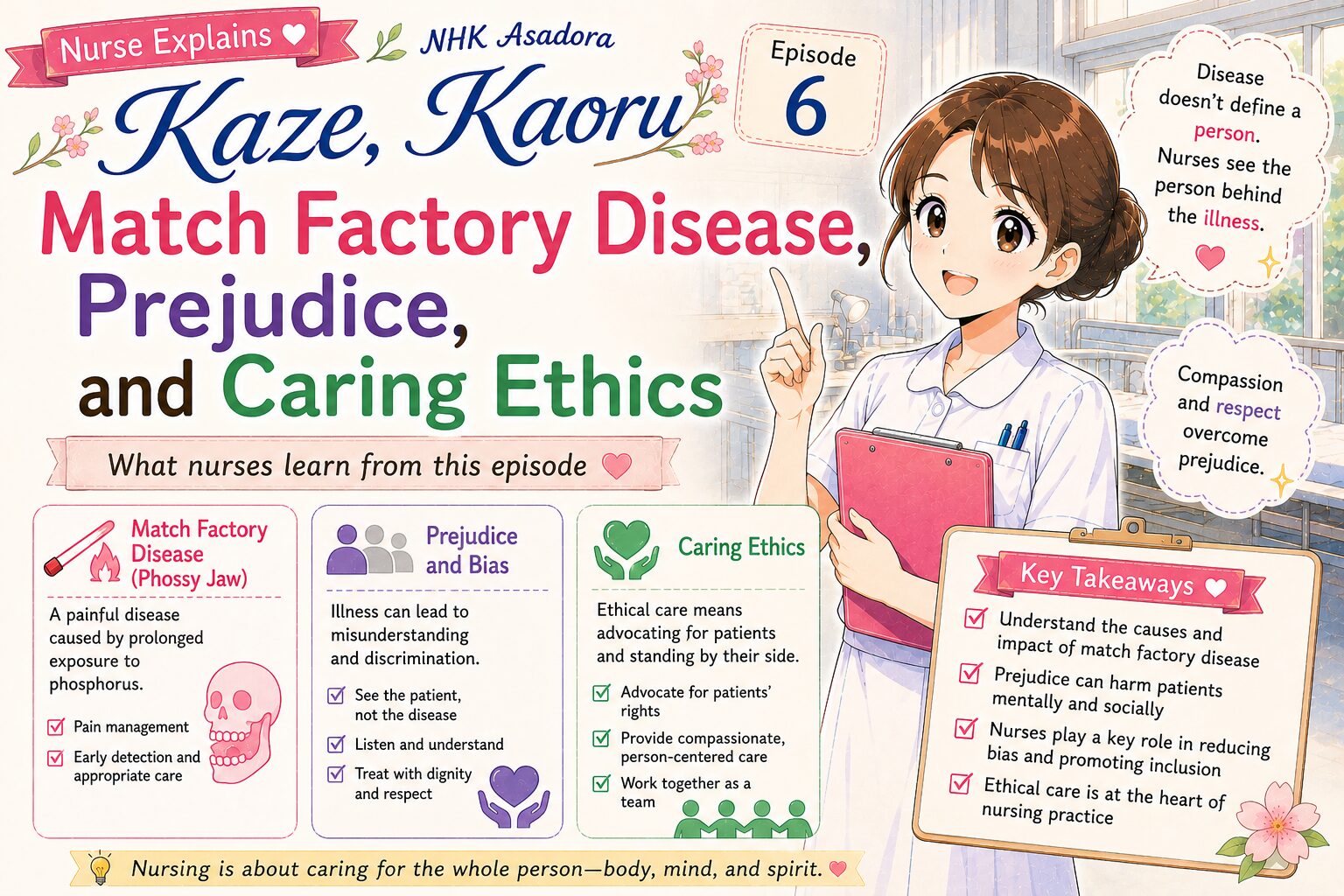
What you will learn from this article
✅ The main story of Episode 6 of Kaze, Kaoru
✅ What occupational disease in match factories meant for women workers
✅ How prejudice can damage care and human dignity
✅ How nursing ethics connects to assumptions, silence, and injustice
✅ Shi-chan’s nurse-focused explanation of caring and emotional labor
This is an English version based on the Japanese article about Episode 6 of the NHK morning drama Kaze, Kaoru. This episode focuses on suspicion, prejudice, match factory occupational disease, nursing ethics, and the meaning of caring.

Shi-chan, Episode 6 felt unfair and painful. Naomi was suspected without real evidence, and it made me think about how easily people can be judged by assumptions.

Yes. Episode 6 is very important from a nursing perspective. It shows that prejudice is not only a social issue. It can directly affect care, assessment, communication, and dignity. Nurses need to notice when assumptions are shaping how we see someone.
- Episode 6 Summary: Suspicion, Social Pressure, and Two Women Facing Injustice
- Match Factory Occupational Disease: A Nursing View
- Prejudice Can Break Care Before It Begins
- Caring: The Power of Simply Being Beside Someone
- The Silence of “I Cannot Say It”
- What New Nurses Can Learn from Episode 6
- Shi-chan’s Final Thoughts
- English Summary
- Recommended Resources 🛒
Episode 6 Summary: Suspicion, Social Pressure, and Two Women Facing Injustice
Episode 6 shows two women facing different forms of pressure. Rin, in Tochigi, faces a difficult decision about marriage and her future. Naomi, in Tokyo, faces suspicion and injustice.
Naomi is treated as if she must be guilty simply because of her background. The problem is not only the accusation itself. The deeper problem is that people decide who she is before they truly see her.
At the same time, the episode brings attention to women working in match factories and the health risks connected to that labor. From a nursing point of view, this is an important doorway into occupational health, poverty, gender, and social vulnerability.
The episode asks viewers to think about what it means to care for someone when society has already judged them. That question is deeply connected to nursing ethics.
Match Factory Occupational Disease: A Nursing View
Match factories were historically associated with dangerous working conditions. Workers exposed to phosphorus and poor environments could suffer serious health problems. In many countries, match factory work became a symbol of industrial labor, poverty, women’s exploitation, and occupational disease.
From a modern nursing perspective, this matters because health is not created only inside hospitals. Workplaces, wages, housing, nutrition, gender, and social status all affect health. A patient’s symptoms may be connected to the conditions in which they live and work.
Episode 6 reminds us that nurses need to look beyond the visible complaint. If a worker becomes ill, we must ask what kind of work they do, what substances they are exposed to, how long they work, whether they can rest, and whether they have the power to protect themselves.
Occupational health points for nurses
- Work history can be essential health information.
- Symptoms may be linked to chemical exposure, repetitive labor, dust, poor ventilation, or long hours.
- Poverty can make it difficult for people to leave dangerous work.
- Women workers may face both health risks and social prejudice.
- Nurses should assess the person’s environment, not only the diagnosis.
So when nurses ask about work, it is not just small talk. It can be part of assessment.
Exactly. A patient’s job can tell us about exposure, stress, sleep, nutrition, income, family roles, and barriers to care. Nursing assessment includes the person’s life.
Prejudice Can Break Care Before It Begins
One of the strongest themes in Episode 6 is prejudice. Naomi is not seen as an individual first. She is seen through a label. Once that happens, people stop listening carefully.
In healthcare, this is dangerous. If nurses assume that a patient is exaggerating, irresponsible, difficult, uncooperative, dirty, poor, or “probably like that,” assessment becomes distorted. We may miss pain, fear, abuse, poverty, cognitive changes, or real medical deterioration.
Prejudice does not always appear as open discrimination. Sometimes it appears as tone of voice, delayed response, less explanation, fewer choices, or a lack of trust. That is why nurses must keep reflecting on our own assumptions.
Questions nurses should ask themselves
- Am I listening to this person as an individual?
- Am I assuming the reason for their behavior before asking?
- Would I explain this differently to another patient?
- Am I labeling this patient as “difficult” too quickly?
- What background factors might be influencing this situation?
It is scary because nurses may not even notice their own assumptions.
That is why reflection matters. Nursing ethics is not only about big dramatic decisions. It is also about everyday attitudes: how we speak, how we listen, and whether we truly see the person in front of us.
Caring: The Power of Simply Being Beside Someone
Episode 6 also invites us to think about caring. Caring is not only giving advice or solving a problem. Sometimes caring means staying beside someone when they are isolated, misunderstood, or unable to speak.
In nursing, “being with” a patient can be deeply meaningful. It may look quiet from the outside, but for a patient who feels alone, the presence of a nurse can become a source of safety.
However, caring also includes emotional labor. Nurses absorb sadness, anger, fear, confusion, and grief. If nurses keep giving care without rest or support, they may burn out. Episode 6 therefore connects caring with both compassion and self-protection.
Caring does not mean carrying everything alone
- Listening is care, but nurses also need boundaries.
- Empathy is important, but it should not destroy the nurse.
- Team support prevents emotional isolation.
- Difficult feelings should be shared through reflection and supervision.
- Sustainable caring requires rest, language, and connection.
The Silence of “I Cannot Say It”
Another important theme is silence. People who are judged unfairly may not be able to explain themselves. People in weak social positions may stay silent because speaking up feels dangerous.
Patients also do this. They may not say they are in pain. They may not say they cannot afford medication. They may not say they are being hurt at home. They may not say they do not understand the doctor’s explanation.
Nurses need to notice silence. Silence is not always agreement. Silence can mean fear, shame, confusion, resignation, or exhaustion. Episode 6 helps us remember that what is not said can be as important as what is said.
That makes me think about patients who say “I’m fine” even when they do not look fine.
Yes. Nurses should not force people to speak, but we can create a space where it becomes easier to speak. That is part of caring.
What New Nurses Can Learn from Episode 6
1. Do not let labels replace assessment
Labels are convenient, but they can be dangerous. “Difficult patient,” “noncompliant,” “poor family,” or “attention-seeking” are words that can close the nurse’s eyes. Assessment must begin again with the person in front of us.
2. Social background is part of health
Work, money, family, education, gender, and housing all influence health. Episode 6 reminds us that nurses need to understand the person’s environment, not only the disease.
3. Caring requires both heart and structure
Kindness alone is not enough. Nurses also need ethical thinking, team support, boundaries, and systems that protect both patients and staff.
4. Reflection protects nursing quality
When nurses reflect on their assumptions and emotions, care becomes safer. Reflection helps us notice when prejudice, fatigue, or frustration is changing our behavior.
Reflection questions
Have I ever judged a patient too quickly?
What labels are easy to use in my workplace?
How can I ask about work and living conditions respectfully?
What kind of silence should nurses pay attention to?
How can nurses care without burning out?
Shi-chan’s Final Thoughts
Episode 6 of Kaze, Kaoru is not only about one person being suspected unfairly. It is about the walls created by prejudice, poverty, gender, labor, and silence.
From a nursing perspective, this episode teaches us that care begins when we stop reducing people to labels. Nurses must see the patient’s body, but also their work, family, fear, dignity, and voice.
It also teaches that caring is powerful, but emotionally demanding. Nurses need compassion, but we also need support and boundaries. To care for others sustainably, we must also care for ourselves and our teams.
For nursing students and new nurses, Episode 6 is a reminder: before deciding what kind of person someone is, listen. Before assuming the reason for a behavior, assess. Before judging silence, ask what might make speaking difficult. That is the beginning of ethical nursing care.
I feel like Episode 6 teaches nurses to look behind the surface.
Exactly. Nursing is the work of seeing the person behind the label. When we do that, care becomes more ethical, more human, and safer.
English Summary
- Episode 6 of Kaze, Kaoru focuses on suspicion, prejudice, and women’s labor.
- Naomi is suspected unfairly because people judge her through assumptions.
- The match factory theme connects the story to occupational disease and social vulnerability.
- Nurses need to assess work history, environment, poverty, and exposure risks.
- Prejudice can distort nursing assessment and damage patient dignity.
- Caring means staying beside someone, but nurses also need boundaries and support.
- Silence may mean fear, shame, confusion, or lack of power, not agreement.
- Nursing ethics appears in everyday attitudes, words, and assumptions.
- New nurses should avoid labels and keep seeing each patient as an individual.
- The main lesson is that ethical care begins with listening beyond prejudice.
Recommended Resources 🛒
🛌 看護師の疲れた体に。特許取得の整体枕で熟睡できる眠りを
立ちっぱなしのシフト勤務、夜勤明けの肩こり・首こり……看護師のカラダって毎日本当にしんどいですよね。そんな私が出会ったのが、整体師が開発した特許取得の枕「Cure:Re THE MAKURA」。首・肩・背中のコリをほぐしながら寝られる設計で、翌朝の目覚めが全然違います。ふだん整体に行く余裕がない方にこそ試してほしい一品です。
💼 転職を考えているナースへ。MCナースネットで理想の職場を探そう
「今の職場、なんかしんどいな」と感じたら、それはサインかもしれません。MCナースネットは看護師・保健師・助産師専門の転職支援サービス。担当コンサルタントが非公開求人を含めた情報をもとに、あなたの希望にあった職場を一緒に探してくれます。登録・相談は無料なので、転職を決めていなくても「話だけ聞いてみる」から始めてOKです。
- 非公開求人も多数掲載
- 専任コンサルタントが転職をサポート
- 登録・利用は完全無料
。°+°。°+ °。°。°+°。°+ °。°。°+°。°+ °。°+ °。°
◇◆ 看護師の求人・転職ならMC─ナースネット ◆◇
業界最大級!求人数20000件以上、会員数100,000人の実績!
全国での拠点展開だから身近なコンサルタントに相談可!
大人気の企業・健診・添乗のお仕事も豊富!
登録・お問い合わせはこちら
⇒https://px.a8.net/svt/ejp?a8mat=4AVF01+3RQUPE+28MI+61JSJ
。°+°。°+ °。°。°+°。°+ °。°。°+°。°+ °。°+ °。°
✨ 看護師のスキルアップに。スキンケアアドバイザー資格を自宅で取得
患者さんのスキンケア相談、自信を持って答えられますか?一般社団法人日本スキンケア協会のスキンケアアドバイザー通信講座なら、肌の仕組みから正しいスキンケア方法まで体系的に学べます。自宅学習だからシフト勤務でも無理なく続けられ、取得した資格は患者さんへの指導・美容系への副業・日常生活にも活かせます。
- 自宅で学べる通信講座
- 看護・医療現場での患者指導にも活用できる
- 日本スキンケア協会が認定する公認資格
📚 しーちゃんのおすすめ看護本・国試参考書【Amazon】
「もっと深く勉強したい」「国試に向けてしっかり対策したい」という方へ。Amazonで購入できるおすすめの看護関連書籍をご紹介します。現役ナースの私が実際に使ったり、役立つと感じた本を厳選しています。
コメント