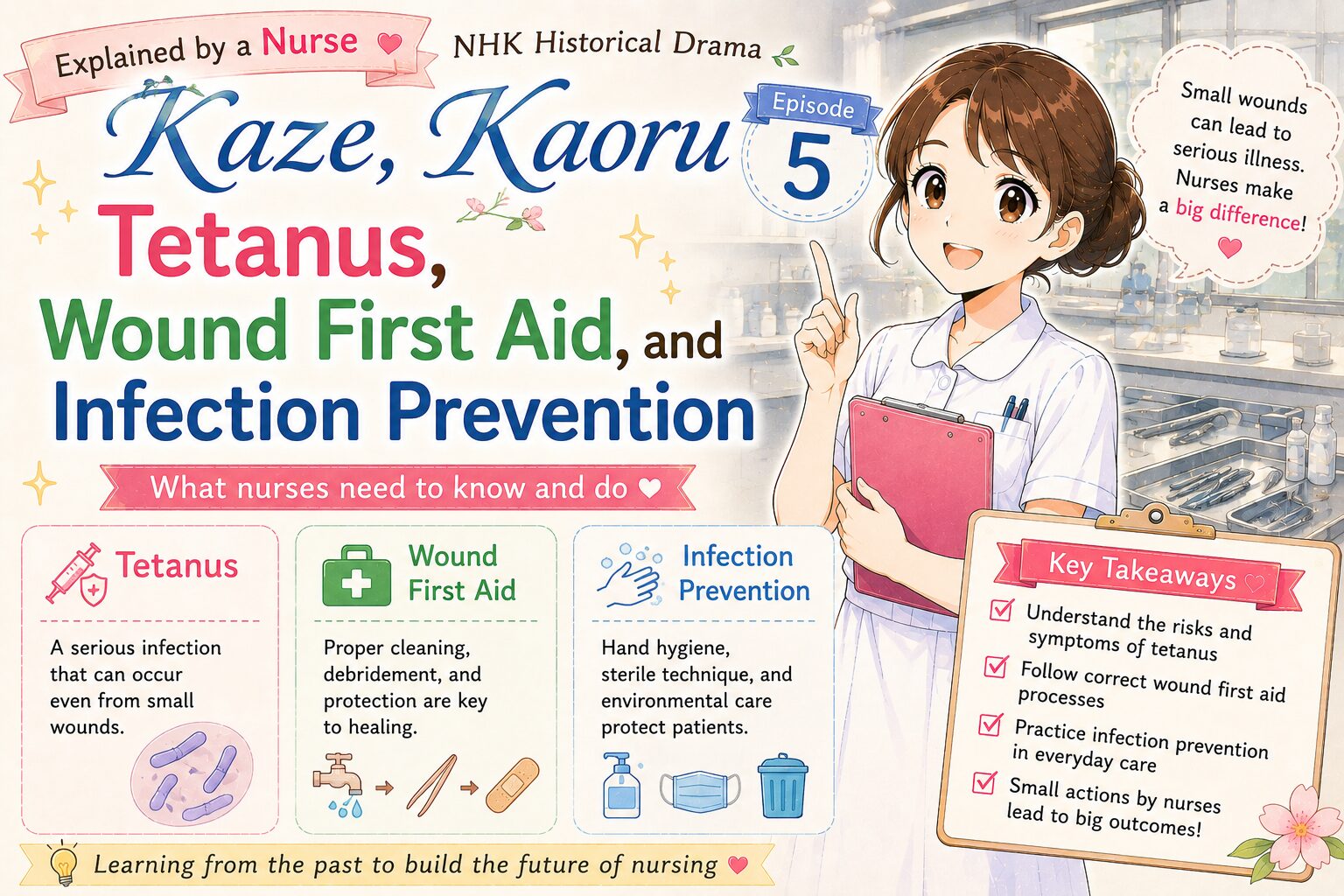
What you will learn from this article
✅ The main story of Episode 5 of Kaze, Kaoru
✅ Why Sutematsu’s warning about tetanus matters from a nursing point of view
✅ Basic first aid for wounds and infection prevention
✅ Why cleanliness was a revolutionary nursing concept in the Meiji era
✅ Shi-chan’s nurse-focused explanation for students and new nurses
This is an English version based on the Japanese article about Episode 5 of the NHK morning drama Kaze, Kaoru. This episode focuses on Sutematsu’s important warning, “Be careful of tetanus,” and connects it to wound care, cleanliness, infection prevention, and modern nursing practice.

Shi-chan, Episode 5 surprised me. Sutematsu saw Rin’s wound and immediately talked about cleanliness and tetanus. It sounded like a small line, but it felt very important.

Exactly. From a nurse’s point of view, that line is huge. It shows the importance of wound care, infection prevention, and the idea that cleanliness is not just manners. It can protect life.
- Episode 5 Summary: Sutematsu’s Warning and Rin’s Turning Point
- Why Sutematsu’s “Be Careful of Tetanus” Is So Important
- Basic First Aid for Wounds: A Nurse’s Perspective
- Cleanliness as a Revolutionary Nursing Concept
- Infection Prevention: What New Nurses Can Learn
- Rin’s Decision and the Theme of Care
- What This Episode Teaches Nursing Students and New Nurses
- Shi-chan’s Final Thoughts
- English Summary
- Recommended Resources 🛒
Episode 5 Summary: Sutematsu’s Warning and Rin’s Turning Point
Episode 5 takes place after the cholera outbreak has begun to settle. Rin and her family are still living with the grief and changes that followed the loss of her father. In this episode, a new encounter becomes important: Rin meets Oyama Sutematsu.
Sutematsu notices Rin’s wound and says something very important from a medical and nursing point of view: the wound must be kept clean, and tetanus must be prevented. In a drama scene, this may sound like a brief line. But for nurses, it contains a deep lesson.
The episode also shows Rin facing a decision about marriage and her future. Her desire to protect her family and move forward is connected with care, responsibility, and self-sacrifice. From a nursing perspective, Episode 5 is not only about a wound. It is also about how people choose their path after loss.
Why Sutematsu’s “Be Careful of Tetanus” Is So Important
Tetanus is a serious infectious disease caused by bacteria that can enter the body through wounds, especially contaminated wounds. Today, vaccination and proper wound care help prevent tetanus, but it remains a dangerous disease if prevention is neglected.
When Sutematsu warns Rin about tetanus, she is showing a modern way of thinking for that era. She does not simply say, “It will heal by itself.” She connects a visible wound to an invisible risk. That is a very nursing-like way of seeing.
Nurses are trained to notice not only what is happening now, but also what could happen next. A small cut can become infected. A dirty wound can become dangerous. A patient who looks stable may deteriorate. This ability to anticipate risk is one of the foundations of nursing.
Sutematsu’s line is powerful because she sees the future risk inside a small wound. That is exactly what nurses do every day: we observe, predict, and prevent complications.
Basic First Aid for Wounds: A Nurse’s Perspective
Episode 5 gives us a chance to review basic wound care. In modern nursing, the first step is not to cover a dirty wound immediately. The first step is to assess and clean it properly.
Of course, serious wounds, deep wounds, animal bites, rusty-object injuries, heavy bleeding, or wounds with signs of infection require medical attention. But the general idea is simple: remove contamination, protect the wound, and watch for changes.
Important points in wound care
- Wash hands before touching the wound.
- Rinse the wound gently with clean running water when appropriate.
- Remove visible dirt if it can be done safely.
- Stop bleeding with gentle pressure using clean material.
- Cover the wound with a clean dressing.
- Observe for redness, swelling, warmth, pain, pus, fever, or worsening symptoms.
- Check tetanus vaccination status when the wound is dirty, deep, or caused by a risky object.
- Seek medical care when the wound is deep, contaminated, painful, or not improving.
I used to think wound care was just putting on a bandage. But there is much more to observe.
Yes. A bandage is only one part. Nurses think about contamination, bleeding, pain, infection signs, vaccination history, and the patient’s overall condition.
Cleanliness as a Revolutionary Nursing Concept
In modern healthcare, cleanliness may feel obvious. We wash hands, disinfect equipment, use clean dressings, and follow infection prevention rules. But historically, the importance of cleanliness was not always understood in the same way.
Florence Nightingale emphasized ventilation, cleanliness, nutrition, and observation. These ideas became central to nursing. In the Meiji era, bringing the concept of cleanliness into daily care was not just a matter of neatness. It was connected to survival.
That is why Sutematsu’s attention to Rin’s wound is meaningful. She represents a way of thinking that connects hygiene with health. She sees cleanliness as care. For nurses, that is a very important lesson.
Cleanliness is not only “looking clean”
- Cleanliness reduces the risk of infection.
- Cleanliness supports wound healing.
- Cleanliness protects both patients and caregivers.
- Cleanliness requires knowledge, not only effort.
- Cleanliness is one of the foundations of safe nursing care.
Infection Prevention: What New Nurses Can Learn
New nurses often learn many infection prevention rules: hand hygiene, standard precautions, gloves, masks, environmental cleaning, waste handling, and safe wound care. At first, these rules may feel like a checklist. But Episode 5 reminds us why they matter.
Infection prevention is a form of kindness. It protects the patient from avoidable harm. It protects the nurse from exposure. It protects families and communities. It also gives patients confidence that they are being cared for safely.
Sutematsu’s warning is short, but it contains this entire way of thinking. A nurse does not wait until infection becomes serious. A nurse tries to prevent it before it begins.
So infection prevention is not just a hospital rule. It is part of caring for someone’s future.
Exactly. Prevention is care. It may not look dramatic, but it can protect a patient’s life.
Rin’s Decision and the Theme of Care
Episode 5 also includes Rin’s decision about her future and marriage. From a nursing perspective, this can be read as a story about care, responsibility, and self-sacrifice. Rin wants to protect her family. She wants to do what seems necessary. But caring for others can sometimes come with the risk of losing sight of oneself.
This theme is also familiar to nurses. Many nurses are deeply motivated by the desire to help others. That motivation is beautiful, but it can become dangerous if it turns into constant self-sacrifice.
Good nursing requires compassion, but it also requires self-preservation. A nurse who never rests, never asks for help, and always sacrifices herself may eventually burn out. Episode 5 gently invites us to think about the balance between caring for others and protecting ourselves.
What This Episode Teaches Nursing Students and New Nurses
1. Small wounds can carry serious risks
A wound may look small, but nurses must think about what could happen next. Infection, delayed healing, pain, tetanus, and functional problems are all possible concerns depending on the situation.
2. Prevention is part of professional care
Nursing is not only responding after a problem appears. It is also preventing complications before they happen. Hand hygiene, wound cleaning, vaccination awareness, and patient education are all preventive care.
3. Patient education matters
When nurses explain why a wound should be cleaned or why tetanus prevention matters, patients can participate in their own care. Education turns fear into action.
4. Caring for others should not erase yourself
Rin’s decision reminds us that care and self-sacrifice can be close together. New nurses should learn early that protecting themselves is not selfish. It is necessary for sustainable nursing.
Reflection questions
What wound signs would make you seek medical attention?
How would you explain tetanus prevention to a patient?
Why is cleanliness a nursing concept, not just a lifestyle habit?
How can nurses balance compassion and self-protection?
What does Sutematsu’s line teach us about anticipating risk?
Shi-chan’s Final Thoughts
Episode 5 of Kaze, Kaoru may seem to focus on a small wound and a short warning, but from a nursing perspective, it is full of meaning. Sutematsu’s words show the power of observation, knowledge, prevention, and cleanliness.
Modern nurses can connect this episode to wound care, tetanus prevention, standard precautions, and patient education. We can also connect it to the emotional theme of caring for others while trying not to lose ourselves.
For new nurses, this episode is a reminder that small observations matter. A wound, a word, a hesitation, or a decision can all reveal something important. Nursing begins when we notice those small signs and think about what the patient may need next.
Now I understand why Sutematsu’s short line mattered so much. She was not just commenting on a wound. She was showing a nursing way of thinking.
Yes. Seeing risk, preventing harm, and caring with knowledge. That is nursing. Episode 5 gives us a beautiful chance to remember that.
English Summary
- Episode 5 of Kaze, Kaoru highlights Sutematsu’s warning about tetanus and cleanliness.
- A small wound can become dangerous if contamination and infection are ignored.
- Tetanus is a serious infection that can enter the body through wounds.
- Modern wound care begins with hand hygiene, cleaning, bleeding control, and observation.
- Cleanliness is not only about appearance; it is a core nursing safety concept.
- Sutematsu’s words show the importance of anticipating future risk.
- Infection prevention protects patients, nurses, families, and communities.
- Patient education helps people understand why wound care matters.
- Rin’s decision also raises the theme of care, responsibility, and self-sacrifice.
- The main lesson is that nursing combines observation, prevention, compassion, and self-protection.
Recommended Resources 🛒
🛌 看護師の疲れた体に。特許取得の整体枕で熟睡できる眠りを
立ちっぱなしのシフト勤務、夜勤明けの肩こり・首こり……看護師のカラダって毎日本当にしんどいですよね。そんな私が出会ったのが、整体師が開発した特許取得の枕「Cure:Re THE MAKURA」。首・肩・背中のコリをほぐしながら寝られる設計で、翌朝の目覚めが全然違います。ふだん整体に行く余裕がない方にこそ試してほしい一品です。
💼 転職を考えているナースへ。MCナースネットで理想の職場を探そう
「今の職場、なんかしんどいな」と感じたら、それはサインかもしれません。MCナースネットは看護師・保健師・助産師専門の転職支援サービス。担当コンサルタントが非公開求人を含めた情報をもとに、あなたの希望にあった職場を一緒に探してくれます。登録・相談は無料なので、転職を決めていなくても「話だけ聞いてみる」から始めてOKです。
- 非公開求人も多数掲載
- 専任コンサルタントが転職をサポート
- 登録・利用は完全無料
。°+°。°+ °。°。°+°。°+ °。°。°+°。°+ °。°+ °。°
◇◆ 看護師の求人・転職ならMC─ナースネット ◆◇
業界最大級!求人数20000件以上、会員数100,000人の実績!
全国での拠点展開だから身近なコンサルタントに相談可!
大人気の企業・健診・添乗のお仕事も豊富!
登録・お問い合わせはこちら
⇒https://px.a8.net/svt/ejp?a8mat=4AVF01+3RQUPE+28MI+61JSJ
。°+°。°+ °。°。°+°。°+ °。°。°+°。°+ °。°+ °。°
✨ 看護師のスキルアップに。スキンケアアドバイザー資格を自宅で取得
患者さんのスキンケア相談、自信を持って答えられますか?一般社団法人日本スキンケア協会のスキンケアアドバイザー通信講座なら、肌の仕組みから正しいスキンケア方法まで体系的に学べます。自宅学習だからシフト勤務でも無理なく続けられ、取得した資格は患者さんへの指導・美容系への副業・日常生活にも活かせます。
- 自宅で学べる通信講座
- 看護・医療現場での患者指導にも活用できる
- 日本スキンケア協会が認定する公認資格
📚 しーちゃんのおすすめ看護本・国試参考書【Amazon】
「もっと深く勉強したい」「国試に向けてしっかり対策したい」という方へ。Amazonで購入できるおすすめの看護関連書籍をご紹介します。現役ナースの私が実際に使ったり、役立つと感じた本を厳選しています。
コメント