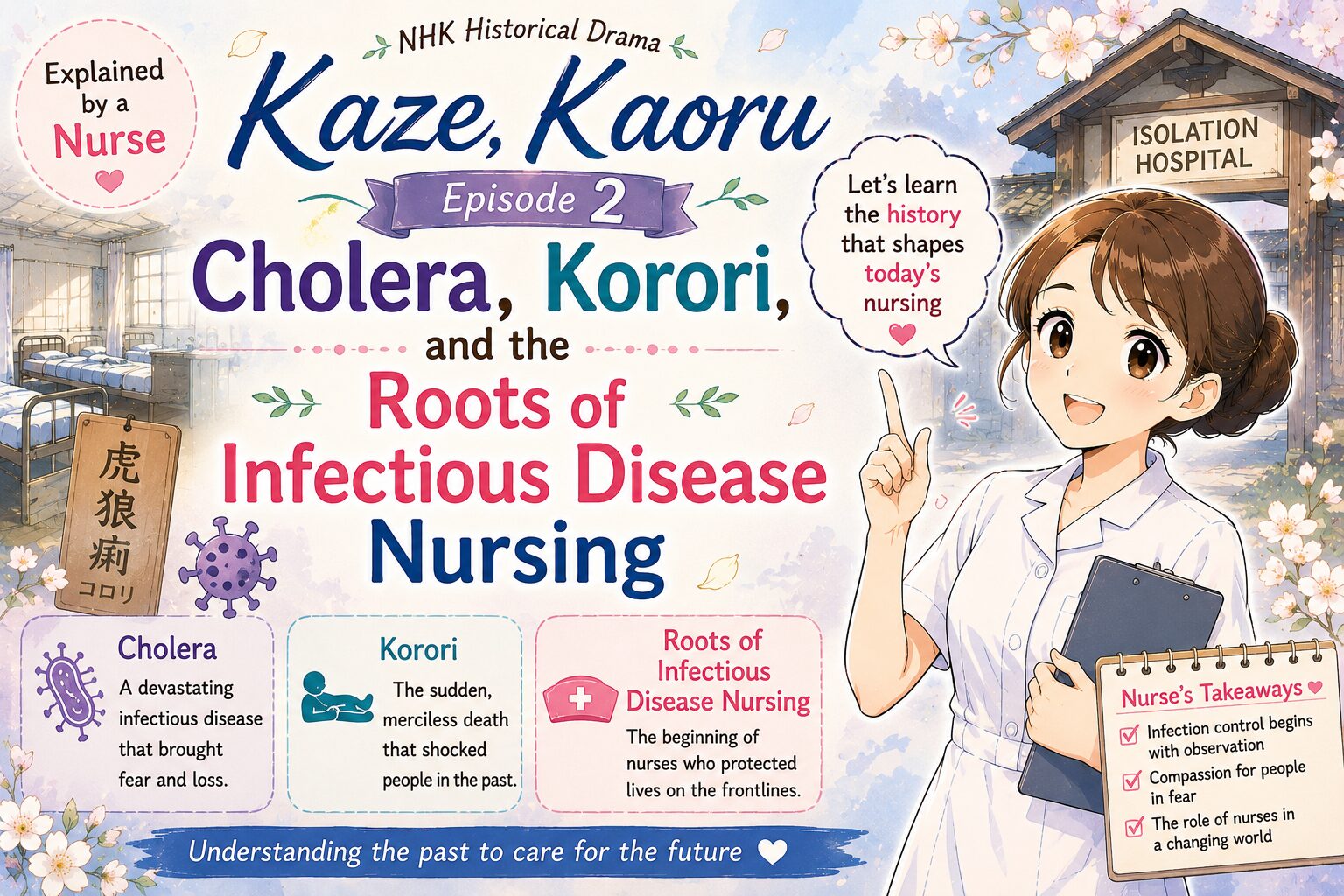
What you will learn from this article
✅ The main story of Episode 2 of the morning drama Kaze, Kaoru
✅ Why cholera was called Korori in the Meiji era
✅ How fear, stigma, and lack of medical knowledge affected communities
✅ What modern nurses can learn from historical infectious disease care
✅ Shi-chan’s gentle nursing perspective for students and new nurses
This is an English version based on the Japanese article about Episode 2 of the NHK morning drama Kaze, Kaoru. The episode focuses on cholera, once commonly called Korori, and shows how infectious disease could suddenly enter an ordinary family’s life.
Shi-chan, Episode 2 felt very heavy. Everyone was living an ordinary life, and then the fear of Korori suddenly appeared. It made me think about how frightening infectious diseases must have been in that era.

Yes. Episode 2 is an important episode for nurses because it shows not only the disease itself, but also fear, confusion, stigma, family love, and the beginning of Rin’s path toward nursing. Let’s look at it carefully from a nurse’s point of view.
- Episode 2 Summary: An Ordinary Life Shaken by Korori
- Why Cholera Was So Frightening in the Meiji Era
- Rin’s Starting Point: The Moment Nursing Becomes Personal
- What Modern Nurses Can Learn from Episode 2
- For New Nurses: How to Read This Episode as a Learning Tool
- Shi-chan’s Final Thoughts
- English Summary
- Recommended Resources 🛒
Episode 2 Summary: An Ordinary Life Shaken by Korori
Episode 2 takes place in a rural area of Tochigi Prefecture in 1885, during the Meiji era. The story begins with the daily life of Rin and her family. At first, the atmosphere feels calm and familiar. People work, talk, eat, and live close to one another.
But behind that ordinary life, the threat of cholera is approaching. In Japan at that time, cholera was often called Korori. The name itself suggests how suddenly and frighteningly the disease could take a person’s life.
For people in the Meiji era, cholera was not simply a medical word. It was a source of panic. Many people did not fully understand bacteria, infection routes, sanitation, or dehydration. When someone became ill, families and communities were often overwhelmed by fear.
Episode 2 shows how infectious disease does not affect only the body. It affects relationships, families, communities, and the way people look at each other. That is why this episode is so important from a nursing perspective.
The word Korori is said to come from the image of a person dying suddenly, almost as if they had fallen over. Whether or not every detail of the origin is exact, the word tells us how terrifying cholera felt to people at that time.
Why Cholera Was So Frightening in the Meiji Era
Today, when nurses hear the word cholera, we think about Vibrio cholerae, contaminated water or food, severe diarrhea, dehydration, oral rehydration, intravenous fluids, infection control, and public health measures.
But in the Meiji era, many people did not have that framework. They saw a person who had been well suddenly develop severe symptoms and become critically ill. Without clear medical explanations, fear could easily turn into rumors, discrimination, and avoidance.
This is one reason Episode 2 is powerful. It helps viewers imagine what infectious disease meant before modern nursing and public health were widely established. The illness itself was dangerous, but the lack of knowledge made it even more frightening.
For nurses, this reminds us that education is part of care. When patients and families do not understand what is happening, fear grows. When nurses explain, listen, and create a sense of safety, care becomes more than a medical procedure.
A Nurse’s View: Disease and Fear Are Both Care Targets
- A disease affects the body, but fear affects behavior.
- Lack of knowledge can create stigma and isolation.
- Families need explanations that match their level of understanding.
- Infectious disease care requires both clinical skill and emotional support.
- Public health begins with accurate information and trust.
So nurses are not only treating symptoms. They are also helping people understand what is happening and reducing unnecessary fear.
Exactly. Infection control is not just about rules. It is also about helping people act safely without blaming or isolating one another. That is a very modern nursing lesson hidden inside this historical story.
Rin’s Starting Point: The Moment Nursing Becomes Personal
In Episode 2, Rin is still living inside the world of her family and community. She is not yet a trained nurse. However, the experience of facing Korori becomes one of the emotional starting points of her future path.
For many nurses, the motivation to enter nursing is not always abstract. It may come from seeing a family member suffer, being helped by a nurse, experiencing loss, or feeling powerless in front of illness. Rin’s story reflects that kind of beginning.
When illness enters a family, people often realize how vulnerable life is. They may also realize how important it is to have someone who can observe, support, explain, and stay beside the patient. That is one of the roots of nursing.
From Shi-chan’s perspective, Episode 2 is not only about cholera. It is about the moment when Rin begins to understand that care requires courage, knowledge, and presence.
What Modern Nurses Can Learn from Episode 2
1. Infectious Disease Care Begins with Observation
In any era, observation is essential. Nurses notice changes in appearance, breathing, skin color, consciousness, urine output, stool, appetite, and behavior. In cholera, dehydration can progress rapidly, so early observation is especially important.
Even when medical tools are limited, careful observation can save lives. Episode 2 reminds us that nursing begins with watching closely and taking small changes seriously.
2. Dehydration Is a Life-Threatening Condition
Cholera can cause massive fluid loss. From a modern nursing point of view, dehydration is one of the most important issues. Nurses must watch for dry mucous membranes, poor skin turgor, low blood pressure, tachycardia, decreased urine output, altered consciousness, and general weakness.
The drama shows the fear of Korori, but nurses can also translate that fear into clinical thinking. What is happening inside the body? What should be observed? What support is needed first? This is how nurses turn fear into action.
3. Infection Control Protects Both Patients and Caregivers
Modern nurses know that infection control is not about avoiding patients. It is about approaching patients safely. Hand hygiene, personal protective equipment, environmental cleaning, proper handling of waste, and safe communication all protect the patient, the caregiver, and the community.
Episode 2 helps us feel why infection control matters. When people do not know how to protect themselves, they may either take dangerous risks or reject the patient completely. Nursing stands between those extremes.
4. Stigma Can Hurt Patients as Much as Illness
Infectious diseases often create stigma. People may blame the patient, avoid the family, or treat the illness as something shameful. This can make patients and families suffer even more.
Nurses have an important role in preventing stigma. We can use accurate words, avoid blaming language, protect privacy, and support families who feel isolated. Episode 2 shows why that kind of support matters.
When I think about it that way, Episode 2 feels connected to modern nursing. Even if the era is different, patients and families still feel fear and loneliness.
That’s right. Technology changes, but the emotional experience of illness often remains similar. Nurses need both scientific knowledge and the ability to stay close to people who are afraid.
For New Nurses: How to Read This Episode as a Learning Tool
If you are a nursing student or a new nurse, you may feel that historical dramas are far away from your daily practice. But Episode 2 can be used as a powerful learning tool.
Try asking yourself: What information did the characters have? What information were they missing? What symptoms should a nurse observe? How could a nurse explain the illness to a frightened family? What kind of words would reduce stigma?
These questions connect drama to nursing practice. You do not need to memorize every historical detail. Instead, use the story to practice clinical imagination. Nursing is the work of imagining what is happening in the body, what is happening in the heart, and what support is needed next.
Questions for reflection
What signs of dehydration would you watch for?
How would you explain cholera to a frightened family?
What words might increase stigma, and what words might reduce it?
How can nurses protect themselves while still providing compassionate care?
What moment in this episode may have influenced Rin’s future path?
Shi-chan’s Final Thoughts
Episode 2 of Kaze, Kaoru is an episode about cholera, but it is also about the birth of a nursing perspective. It shows how illness can suddenly change everyday life and how fear can spread when knowledge is limited.
From a nurse’s point of view, this episode teaches us that care requires more than kindness. It requires observation, knowledge, infection control, explanation, and respect for the dignity of patients and families.
Rin’s journey toward nursing begins in a world where people are frightened and powerless in front of disease. That is why her future as a nurse feels meaningful. Nursing is not only about treating illness. It is about standing beside people when illness disrupts their lives.
For new nurses, this episode is a reminder that your work matters. Even when you feel inexperienced, your observation, your words, and your presence can help someone feel less alone.
Thank you, Shi-chan. I feel like I understand Episode 2 more deeply now. It was not only a sad episode. It was also the beginning of Rin’s nursing story.
Yes. And when we watch it as nurses, we can see that the roots of nursing are always close to people’s fear, grief, and hope. That is why this drama is worth watching carefully.
English Summary
- Episode 2 of Kaze, Kaoru focuses on cholera, called Korori in the Meiji era.
- The episode shows how infectious disease could suddenly disrupt ordinary family life.
- Cholera was frightening because people had limited medical knowledge at that time.
- From a nursing view, dehydration and rapid deterioration are key clinical concerns.
- Observation is one of the most important nursing skills in infectious disease care.
- Infection control protects patients, caregivers, families, and the community.
- The episode also shows how fear can lead to stigma and isolation.
- Nurses help reduce fear by explaining, listening, and using accurate information.
- Rin’s experience with Korori becomes part of her path toward nursing.
- The main lesson is that nursing requires knowledge, courage, and compassion.
Recommended Resources 🛒
🛌 看護師の疲れた体に。特許取得の整体枕で熟睡できる眠りを
立ちっぱなしのシフト勤務、夜勤明けの肩こり・首こり……看護師のカラダって毎日本当にしんどいですよね。そんな私が出会ったのが、整体師が開発した特許取得の枕「Cure:Re THE MAKURA」。首・肩・背中のコリをほぐしながら寝られる設計で、翌朝の目覚めが全然違います。ふだん整体に行く余裕がない方にこそ試してほしい一品です。
💼 転職を考えているナースへ。MCナースネットで理想の職場を探そう
「今の職場、なんかしんどいな」と感じたら、それはサインかもしれません。MCナースネットは看護師・保健師・助産師専門の転職支援サービス。担当コンサルタントが非公開求人を含めた情報をもとに、あなたの希望にあった職場を一緒に探してくれます。登録・相談は無料なので、転職を決めていなくても「話だけ聞いてみる」から始めてOKです。
- 非公開求人も多数掲載
- 専任コンサルタントが転職をサポート
- 登録・利用は完全無料
。°+°。°+ °。°。°+°。°+ °。°。°+°。°+ °。°+ °。°
◇◆ 看護師の求人・転職ならMC─ナースネット ◆◇
業界最大級!求人数20000件以上、会員数100,000人の実績!
全国での拠点展開だから身近なコンサルタントに相談可!
大人気の企業・健診・添乗のお仕事も豊富!
登録・お問い合わせはこちら
⇒https://px.a8.net/svt/ejp?a8mat=4AVF01+3RQUPE+28MI+61JSJ
。°+°。°+ °。°。°+°。°+ °。°。°+°。°+ °。°+ °。°
✨ 看護師のスキルアップに。スキンケアアドバイザー資格を自宅で取得
患者さんのスキンケア相談、自信を持って答えられますか?一般社団法人日本スキンケア協会のスキンケアアドバイザー通信講座なら、肌の仕組みから正しいスキンケア方法まで体系的に学べます。自宅学習だからシフト勤務でも無理なく続けられ、取得した資格は患者さんへの指導・美容系への副業・日常生活にも活かせます。
- 自宅で学べる通信講座
- 看護・医療現場での患者指導にも活用できる
- 日本スキンケア協会が認定する公認資格
📚 しーちゃんのおすすめ看護本・国試参考書【Amazon】
「もっと深く勉強したい」「国試に向けてしっかり対策したい」という方へ。Amazonで購入できるおすすめの看護関連書籍をご紹介します。現役ナースの私が実際に使ったり、役立つと感じた本を厳選しています。
コメント