Hello!
Today’s topic is information gathering — specifically, information gathering on night shifts.
No time at all! Can’t answer senior questions without solid info! Unknown terms, unreadable abbreviations, overwhelming text, can’t summarize, can’t even find the diagnosis name… Have you ever panicked and performed worse than usual because of all this pressure?

I really have no time! How am I supposed to gather info on twice as many patients as daytime? How does anyone do it??

I completely understand that feeling. I spent years asking myself how to get better at this, too — haha.
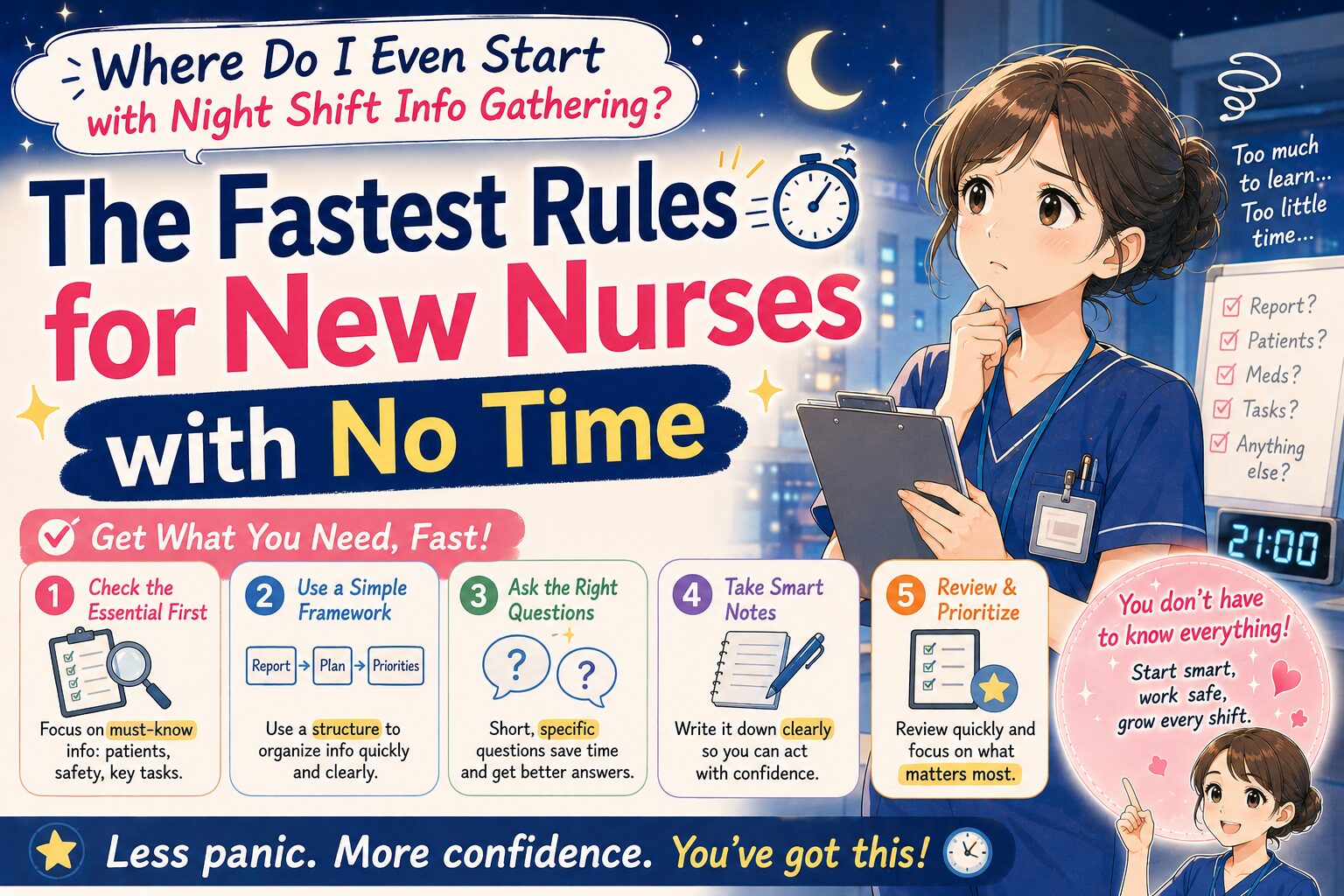
The Core Answer: 3 Rules for Night Shift Info Gathering
Here is the conclusion for night shift information gathering:
• Listen carefully to the handoff from day-shift nurses, and clarify anything you don’t understand
• In the electronic chart: Doctor’s notes → Doctor’s orders → Nursing records
• Double-check IVs and oral medications thoroughly
① Listen carefully to handoffs — clarify what you don’t understand
It might sound obvious, but obvious things are important precisely because they’re obvious.
Even after reviewing the electronic chart, you still need to know: how did the treatment go today? What should I watch for tonight? Was there any agitation during the day? What does this term mean?
The honest truth is: the handoff is the only place to get this.
During handoffs I’m so focused on just keeping up that I never know what to write down… and before I know it, it’s over. 😰
Totally get it! You don’t need to understand everything perfectly from the start. During handoff, just grab these 3 things: “what might happen tonight,” “anything different from usual,” and “anything I’m unsure about.” Unknown words? Ask immediately on the spot. Seniors trust a nurse who asks and confirms over one who panics during an emergency from not asking. Think of handoff not as “a time to understand everything” but as “a time to receive your map for the night.” 🗺️
💚 Shi-chan’s 3 Must-Capture Points During Handoffs
① “What might happen tonight” — Unstable vitals, post-op patients, ongoing fever: who needs special attention tonight?
② “Anything different from usual” — A fall during the day, agitation, a family complaint: what changed since yesterday?
③ “Anything you’re unsure about” — Unknown terms, unclear orders, patient status questions: ask every single one right then and there.
Rough notes are fine. After handoff, cross-reference with the chart and clean up. Do NOT try to write perfect notes during handoff — missing important updates is 100x scarier. 🗺️
Asking seniors lots of questions might feel difficult — but reframe it this way:
• Clarifying something means you’ll understand the patient correctly — that directly benefits your patient
• Having clarity builds confidence in your own words and decisions
• If you don’t ask one senior, another senior will challenge you on it later anyway — so ask for the patient’s sake
During chart review, flag anything you need to follow up on so you don’t forget.
② Electronic chart order: Doctor’s notes → Doctor’s orders → Nursing records
The key to efficient info gathering is extracting what you need from the electronic chart as fast as possible.
When I look at the chart, I start thinking “maybe I need this too, and this too” and time just disappears!
Right? It becomes endless because you want to know everything about the patient. Night shift info gathering is always a race against time — you have to be selective.
Too much information in the chart… I get lost deciding where to start, and the clock keeps ticking. 😱
Shi-chan struggled with this for years too, haha. But here’s the one trick: think of the electronic chart like a TV news show. You’re not reading every article in depth — you’re scanning for “the top headline for tonight first.” Doctor’s chart = today’s changes and assessment. Doctor’s orders = tonight’s timed tasks and PRN conditions. Nursing records = did anything happen on the last night shift? Do a quick “high-speed scan” of these 3 first, then fill in the details with whatever time is left. Just following this order will completely change how fast you gather info. ✨
Everyone has their own approach, but here’s one solid framework:
Step 1: Doctor’s chart → Diagnosis → Medical history + reason for admission → Today’s doctor’s notes
• Diagnosis: After “#,” listed in priority order. The top one is usually what this admission is about.
• Medical history/reason for admission: Just a quick overview. Medical history is crucial for understanding overnight blood sugar checks or any complications.
• Today’s doctor’s notes: Skim for today’s events and patient status.
Step 2: Doctor’s orders — Watch for outdated orders mixed in with current ones. Key things NOT to miss: timed overnight tasks, activity restrictions, orders for when vitals go out of range.
Step 3: Nursing records — Most important to look for: any agitation, delirium, or fall risk. These are critical for patient safety overnight — always check and confirm countermeasures.
③ Double-check IVs and oral medications thoroughly
IVs and medication management are among the most critical tasks on a night shift. Working under time pressure makes errors more likely — never cut corners here.
• Check what IVs are running, and whether the next day’s IVs are already prepared.
• For oral meds, use the prescription sheet to verify every single medication. Medication errors happen more often than you’d think — take the time to check carefully, one by one.
I once had a situation where the continuation IV wasn’t prepared when the date changed at midnight. Always check across the date change.
So many types of IVs — it makes me so anxious. How should I check them? 😟
For IVs, always confirm these 3 things first: “How many bags do I have tonight?” “When does each one finish?” “Is the next bag already prepared?” Especially on shifts that cross midnight, the next IV order may not be in yet — that’s a common trap. For oral meds, read each pill out loud against the prescription and physically match them one by one. Skipping this “because it takes time” is how terrifying medication errors happen. Checking carefully is something seniors are watching for. 👀
I feel like I understand the big picture of info gathering now! Tomorrow I’ll try looking at the chart in “news anchor mode”! 📺
That’s the spirit! Slow is fine at the start. Have a routine, clarify unknowns immediately, summarize your notes, keep updating throughout the shift. Just keeping these in mind, your 3-months-from-now self will be completely different. Shi-chan is always watching your growth. 🌸
Thank you for reading! — Career Support Lab Nurse
🌸 Shi-chan’s Complete Info-Gathering Guide — 6 Key Points for New Nurses
① Build your “standard routine” — Fast senior nurses always follow the same order. Build your own: Handoff → Doctor’s chart (today’s assessment) → Doctor’s orders (overnight tasks + PRN conditions) → Nursing notes (what happened last night) → IV remaining + end times → Medication check. After 20-30 repetitions, your body will move automatically and the anxiety of “did I miss something?” will fade.
② Turn “I don’t know” into your weapon — Mark anything unclear with a “?” during info gathering. Look them up between tasks or after handoff. Don’t let unknowns stop your workflow — collect them, look them up later, and they’ll stick in your memory naturally.
③ Timing and phrasing matter when asking seniors — The best time to ask is right after handoff or in the first 5 minutes of prep, when seniors are still mapping out the night in their heads. Say: “About [Patient X], could I have 1 minute to clarify something?” Ask first, then thank them after. This small habit changes how seniors perceive you.
④ Summarize in your own words — Your notes should capture meaning, not copy text. Example: “Patient A: low-grade fever since yesterday, PRN antipyretic ordered, sleep meds too, fall history — watch closely.” A quick one-liner per patient means you can act without searching through notes mid-shift.
⑤ Keep updating info throughout the shift — Gathering info before the shift is just the start. Vital changes, elimination status, sleep patterns, behavioral changes — mentally update your picture at every check. The nurse who notices “something feels different” is the one who catches early warning signs before a deterioration.
⑥ The fastest path to improvement — After every night shift, spend 30 seconds thinking: “What was missing from my info gathering? What did I miss? What would I do differently?” Not self-criticism — just calibration. Every shift, a little bit better. That’s the whole game. 🌸
Shi-chan’s Recommended Resources 🛒
🛌 看護師の疲れた体に。特許取得の整体枕で熟睡できる眠りを
立ちっぱなしのシフト勤務、夜勤明けの肩こり・首こり……看護師のカラダって毎日本当にしんどいですよね。そんな私が出会ったのが、整体師が開発した特許取得の枕「Cure:Re THE MAKURA」。首・肩・背中のコリをほぐしながら寝られる設計で、翌朝の目覚めが全然違います。ふだん整体に行く余裕がない方にこそ試してほしい一品です。
💼 転職を考えているナースへ。MCナースネットで理想の職場を探そう
「今の職場、なんかしんどいな」と感じたら、それはサインかもしれません。MCナースネットは看護師・保健師・助産師専門の転職支援サービス。担当コンサルタントが非公開求人を含めた情報をもとに、あなたの希望にあった職場を一緒に探してくれます。登録・相談は無料なので、転職を決めていなくても「話だけ聞いてみる」から始めてOKです。
- 非公開求人も多数掲載
- 専任コンサルタントが転職をサポート
- 登録・利用は完全無料
。°+°。°+ °。°。°+°。°+ °。°。°+°。°+ °。°+ °。°
◇◆ 看護師の求人・転職ならMC─ナースネット ◆◇
業界最大級!求人数20000件以上、会員数100,000人の実績!
全国での拠点展開だから身近なコンサルタントに相談可!
大人気の企業・健診・添乗のお仕事も豊富!
登録・お問い合わせはこちら
⇒https://px.a8.net/svt/ejp?a8mat=4AVF01+3RQUPE+28MI+61JSJ
。°+°。°+ °。°。°+°。°+ °。°。°+°。°+ °。°+ °。°
✨ 看護師のスキルアップに。スキンケアアドバイザー資格を自宅で取得
患者さんのスキンケア相談、自信を持って答えられますか?一般社団法人日本スキンケア協会のスキンケアアドバイザー通信講座なら、肌の仕組みから正しいスキンケア方法まで体系的に学べます。自宅学習だからシフト勤務でも無理なく続けられ、取得した資格は患者さんへの指導・美容系への副業・日常生活にも活かせます。
- 自宅で学べる通信講座
- 看護・医療現場での患者指導にも活用できる
- 日本スキンケア協会が認定する公認資格
📚 しーちゃんのおすすめ看護本・国試参考書【Amazon】
「もっと深く勉強したい」「国試に向けてしっかり対策したい」という方へ。Amazonで購入できるおすすめの看護関連書籍をご紹介します。現役ナースの私が実際に使ったり、役立つと感じた本を厳選しています。

コメント