Hi, I’m Shi-chan! 😊
I’m an active nurse, certified critical care nurse, and have completed advanced nursing practice training. While working clinically every day, I share nursing and medical knowledge on this blog in an easy-to-understand way.
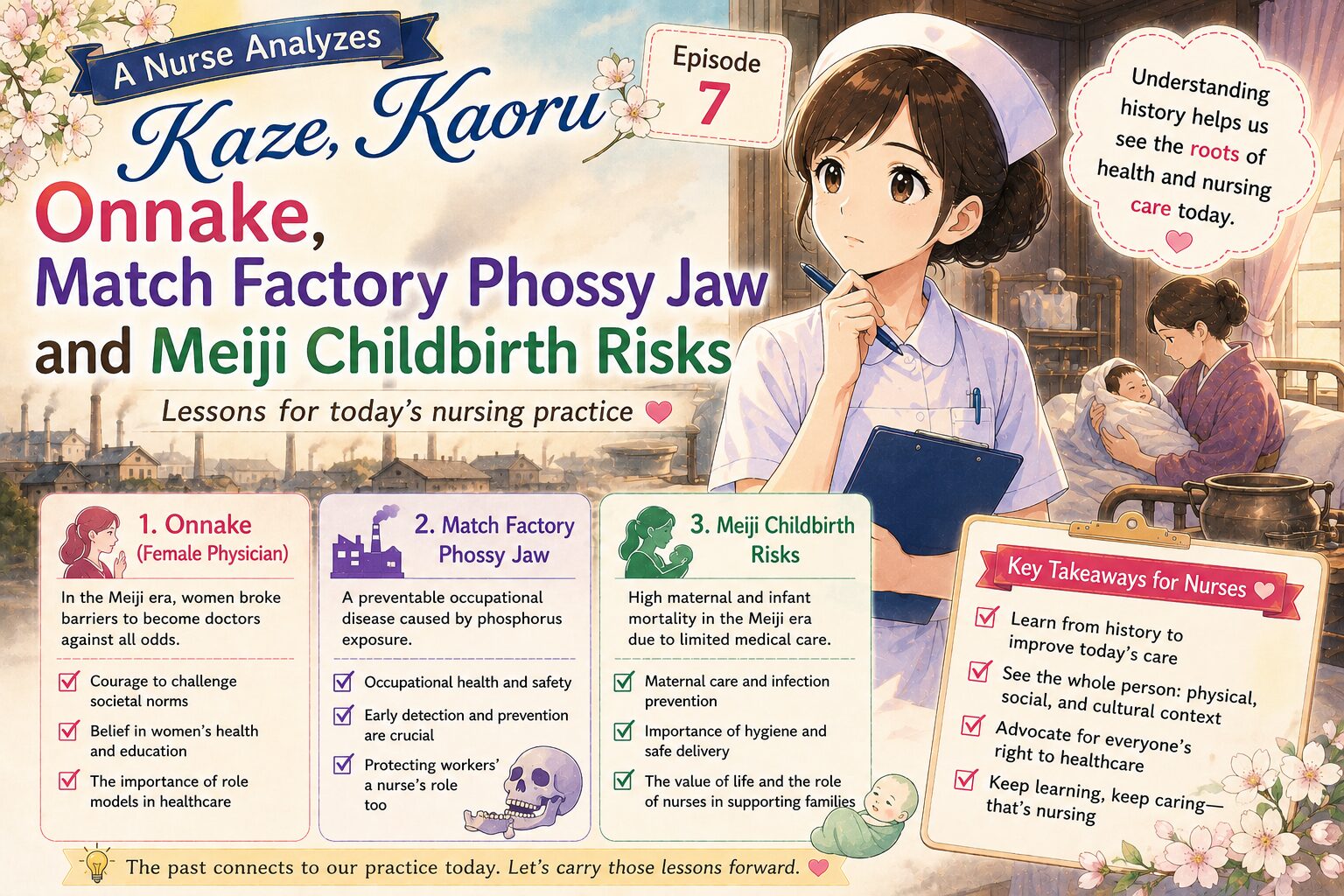
Today I’m giving a deep-dive nurse’s perspective on Episode 7 of the NHK morning drama “Kaze, Kaoru” (aired April 7, 2026)!
Episode 7 is titled “Onnake” (a girl) — Rin gets married and begins her life in the Okuda household. Her husband Kamekichi’s drinking problem, the dismissive word he utters when their daughter is born, and the moment Rin — who has never cried before — finally breaks down and weeps. It’s a scene that cuts deep.
“This doesn’t seem directly related to nursing,” you might think — but through a nurse’s lens, this episode is packed with themes of women’s health in the Meiji era, gender inequality, childbirth risks, occupational disease, and the very roots of Rin’s motivation to become a nurse.
📺 What you’ll learn in this article
✅ A summary of Episode 7 “Onnake” from Shi-chan’s nursing perspective
✅ Life as a “bride” in Meiji Japan — mental and physical health impacts
✅ Naomi’s match factory job and “phossy jaw” — a history of occupational disease
✅ The word “Onnake” and Meiji-era gender views on health
✅ Childbirth risks and postpartum care in the Meiji era
✅ A nurse’s reading of Rin’s true motivation to become a nurse
- Episode 7 “Onnake” Summary — Rin Gets Married
- Nurse Analysis ①: The Match Factory and “Phossy Jaw” — A History of Occupational Disease
- Nurse Analysis ②: Life as a “Bride” in Meiji Japan — Impact on Women’s Mental and Physical Health
- Nurse Analysis ③: Childbirth in Meiji Japan — Assessing the Risks of “Having a Baby”
- Nurse Analysis ④: “Rin Finally Cried” — The Health Impact of Suppressing Emotions
- What Truly Motivated Rin to Become a Nurse — A Nurse’s Reading
- Women’s Health Disparities in Meiji Japan — Lessons for Today
- Q&A: Nursing Questions from Episode 7 — Answered
- Q. As a nurse, how should I approach a patient who has a husband with DV risk (like Kamekichi)?
- Q. How do you identify postpartum depression?
- Q. Is there a modern treatment for phossy jaw, the match factory occupational disease from the Meiji era?
- Q. How should I approach a patient who has suppressed their emotions for a long time?
- Q. Does a childhood like Rin’s — full of suppression and hardship — affect career choice?
- Summary: Episode 7 Is About “the Roots of Why Rin Chose Nursing”
- Recommended Resources 🛒
Episode 7 “Onnake” Summary — Rin Gets Married
Episode 7 opens with Rin’s wedding ceremony. Watched by her mother Mitsu (Miki Mizuno), her sister An (Mie Hayasaka), and Nakamura (Ryu Kobayashi), Rin is married into the household of Kamekichi Okuda (Takahiro Miura), a man who built his fortune in the Meiji-era transportation industry.
The Okuda family rose from former express messengers to success in modern transport. Kamekichi is 17 years older than Rin and a heavy drinker. He resents his educated wife, and the couple’s relationship is strained from the very beginning.
His mother Tei (Kie Negishi) says “Having a daughter of a house chief give birth raises the family’s prestige.” This single line reveals that Rin was brought into the household not as a person, but as a tool to elevate the family’s social standing.
Rin tries desperately to build a warm relationship, but Kamekichi’s drinking and his resentment of her education stand in the way.
A daughter is born the following year — the word “Onnake”
The following year, Rin gives birth. But when Kamekichi learns the baby is a girl, he says only “Onnake” (just a girl) and walks away without naming the child, leaving everything to his wife.
Rin — who did not cry even at her father’s death — cries for the first time here. Holding her newborn daughter Tamaki (Ruka Miyajima), she weeps — a mix of grief, resignation, and the quiet strength to keep going.
Naomi is working at a match factory
Meanwhile, the story also follows Naomi (Juri Uesaka), Rin’s classmate. At this point in the story, Naomi is working at a match factory. Through a nurse’s eyes, this detail sets off alarm bells.
Nurse Analysis ①: The Match Factory and “Phossy Jaw” — A History of Occupational Disease
White phosphorus matches and phossy jaw
Match factories in the Meiji era used white phosphorus — and with it came a terrifying occupational disease: phossy jaw (phosphorus necrosis of the jaw). The symptoms were devastating:
- Necrosis (death) of the jawbone (mandible and maxilla)
- The jaw glowing green in the dark due to phosphorus accumulation
- Jaw swelling, severe pain, and discharge of pus
- Collapse and deformity of the jawbone — ultimately, poison spreading throughout the body and death
Workers spent long hours in poorly ventilated factories breathing in phosphorus fumes, and many developed these symptoms over time. In the modern era, this type of working environment would be completely unacceptable.
Connection to modern occupational diseases
Occupational diseases like phossy jaw were not limited to the Meiji era. Even today, various industries carry occupational health risks:
- Construction and factory workers: mesothelioma and lung cancer from asbestos exposure
- Agricultural workers: nerve damage and skin disease from pesticide exposure
- Nurses and healthcare workers: back injury, infection risk, and burnout
- Night shift workers: circadian rhythm disorders and lifestyle disease risk
As nurses, understanding the relationship between a patient’s occupation and their health is a core part of our assessment. “What is your job?” is not small talk — it can be the most important question.

The scene where Naomi is working cheerfully at the match factory gave me chills as a nurse. Meiji-era match factories used white phosphorus, which caused phossy jaw — a devastating occupational disease. The jaw would rot and literally glow green in the dark. I was watching the screen with my heart pounding.
I’d never heard of phossy jaw before… it sounds horrifying.
White phosphorus enters the body and causes jawbone death. It starts as tooth pain, but gradually the jaw starts glowing and rotting. This kind of working environment would be absolutely unacceptable today.
Nurse Analysis ②: Life as a “Bride” in Meiji Japan — Impact on Women’s Mental and Physical Health
Through a nurse’s eyes, Rin’s life in the Okuda household represents an environment of “chronic stress,” “loss of social support,” and “absence of autonomy” all at once.
The role of a wife in Meiji Japan
In the Meiji era, a wife’s role was clearly defined:
- Obey her husband and his family (“the family” came first in all things)
- Handle all housework, childcare, and assistance with the family business
- Bearing an heir (a son) was considered her “mission”
- Expressing her own opinions or emotions was suppressed
- Ties with her birth family were often severed (loss of social support)
From a modern medical perspective, this is an environment that leads to chronic stress, elevated cortisol secretion, reduced immune function, and increased risk of depression. The time Rin spent trying to build a loving marriage was also a battle against mental exhaustion.
“Getting married” as a life turning point and health
Even today, “moving,” “marriage,” and “childbirth” are measured as high-stress life events in stress research (the Holmes and Rahe Stress Scale). Marriage ranks as one of the top high-stress events.
On top of this, Rin faced “moving to an unfamiliar place,” “a husband who resents her education,” and “a mother-in-law who sees her as a tool.” In modern terms, this is a stress environment that would warrant a visit to a psychosomatic medicine clinic.
“Listen well to what your husband says” — the weight of a mother’s words
Mitsu’s parting words to Rin: “Listen well to what your husband says.” These were her mother’s best attempt at advice within the social norms of the time.
But these words also planted in Rin the belief that “I must not have my own opinions” and “obedience is right.” Modern domestic violence (DV) research shows that this kind of “it’s natural to obey” mindset can delay victims from recognizing abuse for what it is.
From a nursing perspective, what Rin goes through is an environment of “environmental stress,” “loss of social support,” and “loss of autonomy” all hitting at once. Moving away from home into a stranger’s household, obeying the husband’s family, being unable to voice your opinions — modern medicine confirms this causes serious mental and physical damage.
The way Rin tried to keep smiling through it all made it even more heartbreaking…
Exactly. “Keeping a smile” while suppressing your true feelings is itself a form of emotional labor. As a nurse, when I see a patient who’s always smiling, I actually pay closer attention. “Are you really okay?” is often the most important question.
Nurse Analysis ③: Childbirth in Meiji Japan — Assessing the Risks of “Having a Baby”
The scene where Rin gives birth and holds her daughter while crying — behind it lies the fact that she “survived.” Childbirth in the Meiji era carried risks that are incomparable to today.
Maternal mortality in Meiji Japan
The maternal mortality rate in Meiji-era Japan was shockingly high by modern standards. It was an era of poor sanitation and a shortage of trained obstetricians and midwives. The main causes of death were:
- Puerperal fever (childbed fever): bacterial infection after delivery — treatable with antibiotics today, but fatal at the time
- Uterine atony and hemorrhage: massive bleeding from failure of the uterus to contract — no blood transfusions or IV fluids meant immediate death
- Difficult labor and abnormal fetal position: cesarean section techniques were primitive; prolonged labor endangered both mother and child
- Postpartum malnutrition: anemia and undernutrition impeded recovery
The fact that Rin held her daughter safely means she survived these dangers. Her tears held within them not only grief but relief at having come through alive.
What is “postpartum care” (the puerperium)?
In modern nursing, the period after delivery is called the “postpartum period” (puerperium), and special care is provided for the mother’s recovery:
- Monitoring uterine involution (the uterus returning to its original size)
- Wound care and hygiene management of the perineum
- Breastfeeding support
- Postpartum depression screening and mental health care
- Ensuring adequate sleep, nutrition, and rest
Today, postpartum depression is especially emphasized for early detection. It’s estimated that 10–15% of women experience postpartum depression within two weeks of delivery, and nurses regularly screen for postpartum mental health status.
In Rin’s case — told “just a girl” by her husband, with limited social support — the postpartum depression risk was extremely high. The tears Rin shed surely also carried the emotional vulnerability of the postpartum period.
“I wanted a boy” — sex preference and nursing
Kamekichi’s word “Onnake” (just a girl) is a symbol of the “male superiority” values of the era. Boys were the family heir and family asset, and girls being treated as “unwanted” was not uncommon.
Even today, gender-based value differences persist in some regions and cultures. As nurses working with patients of diverse cultural backgrounds, we are called to understand those values while maintaining the ethical nursing position that “every life has equal value.”
The scene where Rin holds back tears after being told “Onnake” really broke my heart… it felt like being denied everything with a single word.
That scene overlapped in my mind with patients I’ve seen crying. More than saying “It’s okay,” sometimes just being beside someone, not dismissing their tears, is what matters. For Rin, giving the name “Tamaki” was probably the only act of resistance she had — her own feelings quietly embedded in that name.
Thinking of it that way makes the naming scene look so different…! It wasn’t just a name at all.
Nurse Analysis ④: “Rin Finally Cried” — The Health Impact of Suppressing Emotions
“Rin, who hadn’t even cried at her father’s death, cried for the first time here.” This depiction is not just a moving scene — it can be read through a nursing lens as the theme of emotional suppression and its release.
What does “not being able to cry” mean?
Rin was raised in a samurai family in the Meiji era. She grew up under the norm that “you must not show emotions” and “you must be strong.” Even at her father’s death — a profound grief — she was unable to express it through tears.
From a medical perspective, chronic emotional suppression has well-documented health consequences:
- Chronically elevated stress hormones (cortisol)
- Reduced immune function (increased susceptibility to infection)
- Increased risk of psychosomatic illness (peptic ulcer, irritable bowel syndrome, tension headaches)
- Emotional “numbing” — becoming less able to feel joy, anger, or sadness
- Risk of transitioning into depression
The physiological effect of tears — why crying is good for you
When Rin finally cried, it was more than just an emotional release. From a physiological standpoint:
- Emotional tears contain stress hormones (cortisol, ACTH), which are excreted with the tears
- Crying activates the parasympathetic nervous system, allowing the body and mind to relax
- Endorphins are released, easing pain and sadness
- Crying helps process emotions and prepares you for the next step
As nurses, when a patient cries, we don’t rush to “stop” the tears. Creating a space where it is safe to cry is itself a form of care.
As a nurse, when patients are crying, the most important thing isn’t “what to say.” Staying beside them, not dismissing their tears — that IS nursing care. Rin naming her daughter Tamaki was probably the only form of resistance she had in that moment.
“Tamaki” — a name that holds her hope. Thinking about it that way makes it so meaningful.
Exactly. As a nurse, those moments when patients express something through a name, or a habit, or the way they hold their hands — those details tell us what that person has been carrying. Noticing them is nursing.
What Truly Motivated Rin to Become a Nurse — A Nurse’s Reading
Choosing nursing as a profession is not simply a career choice. For Rin, it was a challenge to “create her own value, by her own will, through her own strength.”
Rather than continuing her life as a bride told she “raises the family’s prestige,” she chose a profession where her knowledge, skills, and judgment could matter to people’s lives — and the experience of Episode 7 lies at the heart of that decision.
Rin was searching for “a place to live on her own terms”
After Episode 7, Rin’s marriage ends. The exact circumstances aren’t shown in detail, but it’s clear that life in the Okuda household was not a place where Rin could be true to herself. A woman of the Meiji era who had lost the “expected path” of marriage and motherhood then chose the unconventional path of nursing.
Looking at that choice through a nurse’s eyes, I read it as Rin’s declaration: “I want to live as myself.” In the Meiji era, nursing was still seen by many as a “lowly profession.” Choosing it anyway meant she was ready to live by her own conscience, no matter what.
“Nursing is a lowly job” — and why Rin crossed that barrier
At the time, the prejudice that “nursing is a degrading profession” was deeply entrenched. That Rin pursued it anyway suggests she carried the conviction: “No matter how I am looked down upon, I will live according to my own conscience.”
This connects directly to the guiding principle shown in her character: “Does this shame my own conscience?” Having experienced “doing the right thing and receiving no recognition” in her marriage, Rin found in nursing a place to live by her conscience. Episode 7 is the backdrop to that discovery.
When a modern nurse is asked “Why did you become a nurse?”
Modern nurses are also asked about their motivation for choosing nursing — in job interviews, introductions, career reflections. “Why nursing?” is a question we all face at various points.
Just as Rin’s motivation was “I want to live by my own strength” and “I want to follow my conscience,” everyone has their own reasons. What matters is whether that motivation still lives in the nursing you do today.
- Q: What was your motivation for becoming a nurse? / A: I wanted a career where I could directly help people — I found that in nursing.
- Q: What do you value most as a nurse? / A: Listening carefully to each patient and providing care tailored to the individual.
- Q: How do you handle difficult situations? / A: I remember why I chose this path, and I rely on my team.
Why did Rin want to become a nurse? Going through all that in the Meiji era — it must have taken incredible courage.
“I want to be useful to someone,” “I want to live by my own strength” — I think those were both there. But what strikes me most is that Rin found a place where she could live according to her conscience. She didn’t choose nursing to escape her marriage. She chose it because it was a profession she could put her whole self into.
Shi-chan, what was your motivation for becoming a nurse?
I wanted to support people at the moments that matter most in life — illness, crisis, facing death. Nursing lets me be there at those pivotal moments. That’s what drew me in. And even now, in the toughest shifts, that feeling comes back.
That’s really moving… it reminds me that nursing is a profession that carries so much meaning.
Rin’s story always brings me back to the basics. Why did I choose this path? What do I want to do with it? Those are questions worth returning to regularly. That’s why watching this drama as a nurse means something.
Women’s Health Disparities in Meiji Japan — Lessons for Today
Watching Episode 7, you can feel how little the women of the Meiji era were able to exercise their right to protect their own health. As nurses, knowing this historical background carries real meaning.
Average lifespan and health of Meiji-era women
The average lifespan of Japanese women in the Meiji era is said to have been around 35–40 years (today it is approximately 87 years). Behind this gap is not only the difference in medical technology, but the fact that women’s social standing directly determined their health.
- No right to medical care: costs money, and women often could not seek it on their own
- No concept of reproductive rights: women had no control over pregnancy and childbirth
- Nutritional inequality: men ate first; women’s nutrition was often insufficient
- Psychological suppression: expressing emotional distress was not permitted, accelerating physical decline
- Social isolation: separated from their birth family, with no support network
The tears Rin shed when she was told “Onnake” — those tears were not only grief. They were also a sign that a woman’s body and mind had been pushed to the limit by the social structure around her.
Gender and health disparities — an ongoing issue
The story of the Meiji era cannot be dismissed as “ancient history.” Even today, “gender and health disparities” is a global challenge in medicine and public health.
- Women are more likely to go undiagnosed or have their symptoms dismissed (particularly for cardiovascular disease, pain conditions)
- Gender-based violence (DV, sexual violence) has serious health impacts
- Mental health issues carry higher stigma for women and are less likely to be sought for
- In some cultures, women’s healthcare decisions are controlled by husbands or family
As nurses, we work with patients of diverse backgrounds. Understanding each person’s life circumstances, social position, and gender-related experiences is the first step toward better care.
Nursing that is aware of “social determinants of health”
Modern nursing increasingly emphasizes the concept of “Social Determinants of Health” — the idea that health is shaped not only by medical care, but by social conditions including education, economics, housing, relationships, and gender.
The “marriage without choice,” “the child whose arrival goes uncelebrated,” the “social isolation” that Rin experienced — these are all social determinants of health. Through this Meiji-era drama, we can develop a nurse’s eye for “the social situation in which a person is placed.”
Social determinants of health… I didn’t realize that concept reached all the way back to Rin’s era.
The concept is modern, but the realities have always existed. What’s changed is that we now have the language and the evidence to see how deeply society shapes health. That’s what makes this drama so valuable — it shows us those realities through story.
Q&A: Nursing Questions from Episode 7 — Answered
Q. As a nurse, how should I approach a patient who has a husband with DV risk (like Kamekichi)?
A. The most important thing is NOT to ask directly “Are you experiencing domestic violence?” This can put the patient on guard and actually make it harder for them to open up. Instead, start with questions like “How is life at home these days?” “Are you sleeping okay?” or “Are there things you find stressful?” Build a safe relationship first, and gently piece together the situation. If DV is suspected, don’t carry it alone — connect with a medical social worker or the hospital’s counseling department right away.
Q. How do you identify postpartum depression?
A. In clinical settings, we use a screening tool called the Edinburgh Postnatal Depression Scale (EPDS). It is typically administered 2–4 weeks after delivery and consists of 10 questions. High scores prompt referral for professional support. But screening tools aren’t everything — in everyday conversation, asking “Are you sleeping?” “Are you eating?” and “Do you have anyone to help you?” matters just as much.
Q. Is there a modern treatment for phossy jaw, the match factory occupational disease from the Meiji era?
A. White phosphorus matches are no longer manufactured, so phossy jaw has effectively disappeared. However, similar symptoms (jaw osteonecrosis) can occur in patients taking bisphosphonates (drugs for osteoporosis) or certain cancer medications — a condition called MRONJ (medication-related osteonecrosis of the jaw). Modern nurses are expected to understand this drug-related risk and communicate the importance of oral hygiene to patients.
Q. How should I approach a patient who has suppressed their emotions for a long time?
A. Rushing to “get them to express their feelings” can backfire. First, create an atmosphere where they feel safe — and make sure there’s no pressure to speak. Questions like “Do you ever find yourself on the verge of tears?” or “If something is hard, do you feel you can tell someone?” can give them permission to have feelings at all. That permission is often the first step.
Q. Does a childhood like Rin’s — full of suppression and hardship — affect career choice?
A. In developmental psychology, adversity and hardship in childhood can, in some cases, generate strong empathy and a drive to “help others.” This is sometimes called “wounded healer” — people who have experienced pain and use that experience as a foundation for supporting others. Rin’s motivation to become a nurse may trace back not only to her marriage but to her entire life history. As nurses, understanding a patient’s life history helps us see not just the illness, but the whole person.
Summary: Episode 7 Is About “the Roots of Why Rin Chose Nursing”
Episode 7, which seems on the surface to be about marriage and family, is rich with medical and nursing themes from a nurse’s perspective. Let me pull together the key points:
- Phossy jaw (phosphorus necrosis of the jaw) from Meiji-era match factories — a lesson in occupational disease still relevant today
- Being a “bride” in the Meiji era: an environment of chronic stress, loss of social support, and loss of autonomy — with concrete mental and physical health impacts
- Childbirth risks and postpartum care in the Meiji era — a reminder of what modern obstetric nursing is built on
- “Not being able to cry” and the health consequences of emotional suppression — and the physiological value of tears
- “Onnake” (just a girl) and gender health disparities — lessons that still resonate today
- Episode 7 is the backdrop to Rin’s motivation to become a nurse: her desire to “live by her own strength and her own conscience”
Rather than just watching this drama as entertainment, reading it through a nursing lens opens up a whole new layer of meaning. I hope to keep walking alongside Rin and Naomi as they grow — and to keep learning from their stories.
I had no idea a single episode could carry so much nursing knowledge! It gives me a lot to think about.
That’s why I love analyzing this drama as a nurse. The stories from the Meiji era connect directly to modern nursing challenges. I’ll keep bringing you these deep dives — see you next episode!
Recommended Resources 🛒
🛌 看護師の疲れた体に。特許取得の整体枕で熟睡できる眠りを
立ちっぱなしのシフト勤務、夜勤明けの肩こり・首こり……看護師のカラダって毎日本当にしんどいですよね。そんな私が出会ったのが、整体師が開発した特許取得の枕「Cure:Re THE MAKURA」。首・肩・背中のコリをほぐしながら寝られる設計で、翌朝の目覚めが全然違います。ふだん整体に行く余裕がない方にこそ試してほしい一品です。
💼 転職を考えているナースへ。MCナースネットで理想の職場を探そう
「今の職場、なんかしんどいな」と感じたら、それはサインかもしれません。MCナースネットは看護師・保健師・助産師専門の転職支援サービス。担当コンサルタントが非公開求人を含めた情報をもとに、あなたの希望にあった職場を一緒に探してくれます。登録・相談は無料なので、転職を決めていなくても「話だけ聞いてみる」から始めてOKです。
- 非公開求人も多数掲載
- 専任コンサルタントが転職をサポート
- 登録・利用は完全無料
。°+°。°+ °。°。°+°。°+ °。°。°+°。°+ °。°+ °。°
◇◆ 看護師の求人・転職ならMC─ナースネット ◆◇
業界最大級!求人数20000件以上、会員数100,000人の実績!
全国での拠点展開だから身近なコンサルタントに相談可!
大人気の企業・健診・添乗のお仕事も豊富!
登録・お問い合わせはこちら
⇒https://px.a8.net/svt/ejp?a8mat=4AVF01+3RQUPE+28MI+61JSJ
。°+°。°+ °。°。°+°。°+ °。°。°+°。°+ °。°+ °。°
✨ 看護師のスキルアップに。スキンケアアドバイザー資格を自宅で取得
患者さんのスキンケア相談、自信を持って答えられますか?一般社団法人日本スキンケア協会のスキンケアアドバイザー通信講座なら、肌の仕組みから正しいスキンケア方法まで体系的に学べます。自宅学習だからシフト勤務でも無理なく続けられ、取得した資格は患者さんへの指導・美容系への副業・日常生活にも活かせます。
- 自宅で学べる通信講座
- 看護・医療現場での患者指導にも活用できる
- 日本スキンケア協会が認定する公認資格
📚 しーちゃんのおすすめ看護本・国試参考書【Amazon】
「もっと深く勉強したい」「国試に向けてしっかり対策したい」という方へ。Amazonで購入できるおすすめの看護関連書籍をご紹介します。現役ナースの私が実際に使ったり、役立つと感じた本を厳選しています。
コメント